Promotion Items

the KILN @Indiegogo
4hr Courses

Dear Friends, Guitaring Passionately has began its inaugural acoustic guitar making process in early 2017. Do stay tuned to the progress thru instagram and Facebook.

Check out our Price Busters

Learn practical guitar maintenance skills in our 4hr Courses. Brochure Download here
Showing posts with label Andy McKee. Show all posts

Saturday, March 9, 2013

More than SIX?

A Jeffrey Yong MonkeyPod Harp
Taken from: http://www.acousticguitarforum.com/forums/showthread.php?t=195959

Arguably the six-string guitar is the most popular musical instrument in the world. There are over 50 million guitar players worldwide. With this sheer number, we have witnesses limitless of styles in playing guitar. Invariably, the design of this instrument has evolved from one era to another. One should not be surprised by the increase in strings on guitar, isn’t it? After all, the popular 12-string guitar has found its way into many genre of music as an accompanying instrument. Have you played a 12-string guitar? Even you have not, chances are you have already seen one.

Mike Doolin's Harp Guitar
In fact, as early as 17th century, there were string instruments that have more than 12 strings. They are of various forms. As music evolves, so did string instruments. In this article, harp guitar is placed in the limelight. I have to emphasize that I am no harp guitar aficionado. Therefore my knowledge in harp guitars is at best infancy. I hope this article can arouse your interest in learning more about this wonderful instrument. For those who are keen to read a professional harp guitarist’s (Dan LaVoie) thoughts and attitude towards playing harp guitar, please scroll to the lower sections right away.

My first encounter with a harp guitar was in Oregon, Portland. I visited Mike Doolin in 2011, a luthier who resides there. Mike has just completed building a harp guitar and I was fortunate enough to sample this multi-string instrument. There are little words to describe the entire experiences. I guess the picture on the above-right said it all.

One may assume that harp guitar originated from two instruments and the successful combination of the two conceives the today harp guitar. Long before harp guitar is called harp guitar, there were already such string instruments being built. Cleary the evolution in string instruments’ design was closely related to builders’ drive to innovate and players desire to create new genre in music. Very often every birth of a new type of musical instrument, the builder has the most influence in coining a name for it. However builders were not specialized in creating names thus the past attempts were arbitrary or blatantly misleading. The picture below is a string instrument built in by Naderman (Jean-Henri), Paris, 1773. It is called bissex, which literally means twice-six.
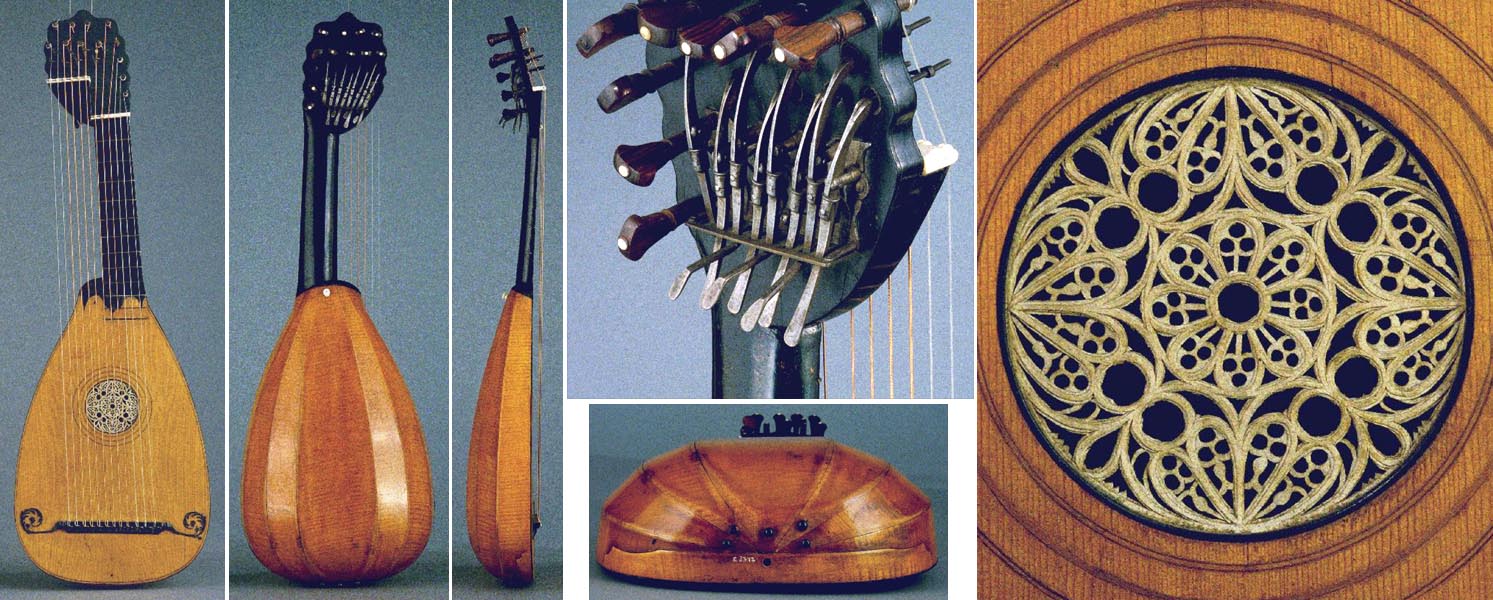
Naderman (Jean-Henri), bissex, Paris, 1773

There is an existing classification system to name musical instruments, i.e. organology. However it isn’t perfect. It was too rigid to accommodate the evolution nature of musical instruments with regards to the evolution of harp guitars. The eventuality was harp guitars carry different names in the past and in different places.

So what is actually a harp guitar? To the regular string instrument enthusiasts the definition is probably straightforward, i.e. the best of harp and guitar combined into a single instrument.

Through my infant attempt to learn more about harp guitar, I found a wonderful website that is dedicated to harp guitars, the www.harpguitars.net. There is no need to search farther about harp guitars once you visit this cool website.

I found these definitions of harp guitars
  • A guitar, in any of its accepted forms, with any number of additional "floating" unstopped strings that can accommodate individual plucking
  • The modern harp guitar must have at least one unfretted string lying off the main fretboard; these unfretted strings are played as an open string
  • The word "harp" is a specific reference to the unstopped open strings, and is not specifically a reference to the tone, pitch range, volume, silhouette similarity, construction, floor-standing ability, nor any other alleged "harp-like" properties.

The amount of literature on harp guitars in harpguitars.net is abundance. To read all of them would take a considerable amount of time. I will make my best attempt to share the interesting perspectives and facts regarding harp guitars in this article.

So what do you play a harp guitar? The simplest answer is just pluck or strum to strings.

The modern harp guitars seen widely today have taken frame design of Chris Knutsen’s one-arm harp guitar, which was patented in 1898 (source: http://www.harpguitars.net/history/patents.htm). Subsequently, the Knutsen design harp guitar got manufactured under William James Dyer& Bro Company and that lead to the birth of Dyer Harp Guitars. The infamous Type 2 that has a cloud bass headstock is probably most liked by harp guitar aficionados. I guess one isn’t a harp guitarist if he or she doesn’t know the Dyer Type 2.

Larson made - Dyer Type 2 1904 to 1920

Most dyer harp guitars have 6 bass sub-bass strings. From my limited knowledge in harp guitars and the playing techniques, the sub-bass strings can take on any tuning as desired by the players. The string gauges are likewise. A certainty is the sustaining notes and overtones from these sub-bass strings. Once pluck, as lauded by Dan LaVoie who is a professional harp guitarists, is likened to stepping on a sustain pedal all the time. It is then necessary to be skillful in sub-bass muting.

Another popular harp guitar is the Sullivan/Elliot design. This design has included super treble strings thus 20 plus strings is common for this design. Below is a Milburn 20-string concert harp guitar, it is a faithful adaptation of the original Sullivan-Elliott harp guitar created with/for John Doan.
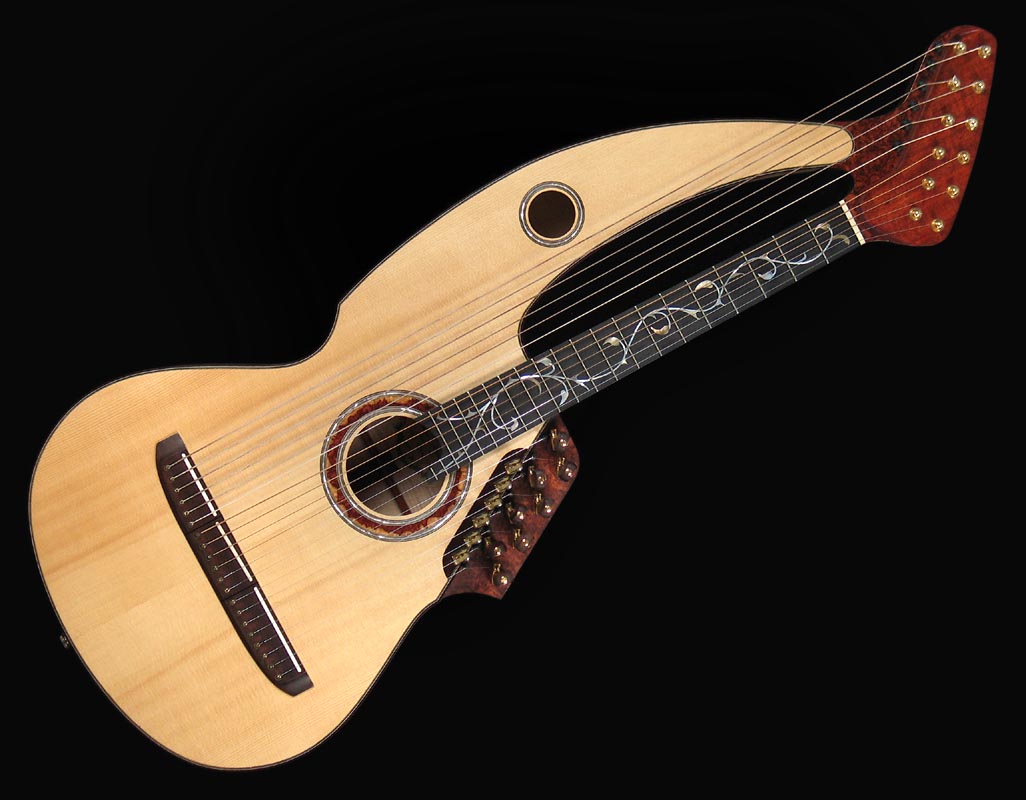
Milburn 20-string concert harp guitar

There is so much more about harp guitars can be shared. However I shall cease discussing about harp guitars at this point and switch to the introduction of Dan LaVoie.

I met Dan in Shanghai in 2011 during the International Finger Style Guitar Festival. He is absolutely cool and approachable. Being the only Harp Guitar player in the festival, he has certainly created an impression. There are many multi-string players but Dan is totally dedicated to harp guitars.

Dan and I
Taken from Dan’s website; “As one of the few musicians in the world actively composing and performing on the rare harp guitar, Dan LaVoie brings a unique sound and texture to fans of acoustic music… After playing the six-string guitar for several years, Dan picked up the harp guitar in 2001 and has since composed solely for this instrument. Bridge Guitar Reviews said Dan’s self-titled 2003 debut album contained “…soulful atmosphere and a skilled and progressive approach to music. The music Dan produces has deep basses and well-executed melody lines.” Click link to read more: http://www.danlavoie.com/

Enjoy a live performance of Dan in YouTube!


Regularly we converse over Facebook chat and I took the opportunity to interview this cool guy. Here it is…

Interview with Dan LaVoie, done over Facebook chat on 5 March 2013.

Me - If a layman asked;"Why are there so many strings on your guitar?" What is your response?
Dan - *laughs* I will explain that it is a harp guitar dating back to the early 19th century. Harp guitarists usually played with a mandolin player and it was called parlor music back then. It was in the 19th century that Harp Guitars fell out of fashion and people stopped playing them. Notably the ripple effects from the great depression has exacerbated the trend to minimize spending on lifestyle related items. The prolonged effects have literally killed the popularity of Harp Guitars because people simply struggled from daily related expenses let alone buying harp guitars. That is the past, at least… My love for this instrument has driven me to take on a personal mission, i.e. to bring it back from the dead and show people how much great music can be created from harp guitar. In contrast to remind string instruments lovers of what they are missing out from such an amazing instrument (Harp Guitar).

Me - So harp guitars fell out favor because they are expensive?
Dan - One of the main reasons I believed. Perhaps the size, and they are certainly harder to pick up if you compare harp to six-string guitars.

Me - Obviously with more strings, musicians will have more options. So what can you get out of Harp Guitars that a regular can't?
Dan - First the low sub basses, the rich complex overtones… almost sounds like a guitar with a sustain pedal on all the time. This brings me to the topic of sub bass muting, but we will get into that later at the workshop. I just fell in love with those tones and harp guitars instantly.

Me- In terms of genre of music, does the nature of Harp Guitar kinda restrict it?
Dan - Definitely not. I believe harp guitars have no boundary to the type of music. It is all up the player.

Me - What might a style of playing you considered not suitable to be executed on a Harp Guitar?
Dan - Well… how about "Heavy Metal?" *laughs*

Me - What about the use of guitar effects for Harp Guitar?
Dan - Well, it depends on the player. I strictly use Tc electronics... the Nova reverb, and the SCF chorus pedal (only for certain parts of a song). My first CD had a song called "On the drive home" which was recorded live in concert using a loop station.

Me - In terms of Harp Guitar players, how do you guys and gals differentiate one from another?
Dan - It boils down to personality. Everyone can play the same song on harp guitar, but each will play it differently due to personality and how one interprets the essence within the song.

Me - Who is your Harp Guitar hero(s)?
Dan - Harp Guitar heros… hmm… First on my mind is Michael Hedges, also Stephen Bennet and Andy Mckee who is like a brother to me. However most of my influences come from Michael Hedges and Richie Havens. Both will remain as my top 2. They have changed my life ever since I learned about their music and playing.

Andy McKee and Dan LaVoie

Me - So Michael Hedges and Richie Havens have inspired you to become a Harp Guitar player?
Dan - Michael Hedges inspired me to find and buy a Harp Guitar. Richie Havens' song writing and rhythm have been the vital influences and sources of inspiration in my development in harp guitar playing, which is something I try to bring into my music. And this year 2013 marks the 10th year of performing and touring with my career as a professional harp guitarists.

Me - Is family support essential to allow you to grow in Harp Guitar playing?
Dan - It was in the beginning, I believe any artist needs family support and a solid foundation in order to gain the strength to work at it.

-End of interview-

Most content written in this article with regards to harp guitar was aided by the literature from www.harpguitars.net. This amazing website is maintained by Gregg Miner. The abundance and detail provided by this website are simply unparalleled. It is already daunting to read all the articles, let alone writing them. I truly appreciate Gregg’s unrelenting attitude in emphasizing accuracy and completeness, which resulted in the many useful harp guitar articles. Thanks for reading!

Monday, February 11, 2013

NAMM 2013 - A view from my eyes

The Main Entrance
One of the many performers

The NAMM was held from 24 to 27 January 2013 in Anaheim, California, USA. This show has been called many things, like the biggest, loudest, most in variety, most crowded, etc. I think calling it a marathon may fit the bill because the amount of distance I have walked in four days could very well cover the entire marathon distance. The size of the exhibition halls in combination is likened to football fields. The number of exhibitors are almost uncountable manually. Everything seems interesting in NAMM whereas some are a lot more. Visitors are either attracted by interest or music and they walk from point-to-point to satisfy their curiosity. I was no exception as well. There are not many free seats for visitors thus standing around is pretty much name of the game. A tiring game I must add…

NAMM Show 2013: http://www.namm.org/thenammshow/2013

Ibanez

Business deals are the main thrust in NAMM, as such it is only for trade and it is not opened to public. In a way it is good for business activities. Unlike Shanghai's Music China, the sheer visitation numbers could dwarf other music trade fairs easily. In such situation, quality is traded for quantity inadvertently. However, if NAMM show wants to drive visitation numbers, reaching out to public is the obvious choice. Well for years, NAMM has never allow numbers to supersedes relevance.

Tech 21
Beautiful Girl, it works all the time

I have heard of the NAMM show for years and it was really a growth opportunity for me to attend the 2013 show. This was made possible by Mi-Si Electronics' invitation. This company produces pickup systems for acoustic guitars. In fact, it is the only active pickup system that doesn't get its power by 9V dry cell instead the pickup gets it juice from ultra-power capacitors. Mikhail, who is the founder of Mi-Si Electronics, he has generously included me as a show visitor. In the show, I have met Mikhail's life partner Simona and Greg Romano who is the Sales Manager.

Mikhail and Greg of Mi-Si Electronics

The love for music as a culture has certainly rooted deeply within the Americans. Playing an instrument seems as common as running, at least in this NAMM show I have observed. It wasn't just recognizing the instruments, most people I saw in NAMM 2013 can really play well. In comparison, Singapore music enthusiasts are way off in terms of the capability to play the musical instruments. Perhaps we can attribute it to the size of the market. Personally I am more inclined to attribute to their passion for music which is intensified by the culture of arts, not forgetting the keen competition among the music enthusiasts to better each other. The music industry doesn't tolerate the half-baked. If you're not up to standard, the natural selection will flush you out of the music industry in no time.

Andy McKee
Thomas Leeb

This is the time of the year for every brand to create impressions to the potential buyers thus they spare no effort to attain that. Big brands like Fender, Gibson, Taylors, Godin, Roland, Yamaha, Peavey, etc. each has its own private exhibition halls and performances. You can expect heavy weight artists to be hired to enhance their positions in the market. They will showcase their best products, some are specially made for the show. Fender made a diamond studded Telecaster which was priced at USD $120,000. When I was photographing it, I realized that the label says "SOLD." Martin Guitars presented a glowing Dreadnought guitar to commemorate her 180th anniversary. Gibson has set up a row of guitars for visitors to get direct hands-on experiences. Each guitar comes with a headphone to allow visitors to listen to the generated sound of each guitar. Many brands have set up live demonstration stations of their products to create instant yet unforgettable experiences for the visitors and buyers. I guess they stop at nothing to make a point.

A USD $120,000 Telecaster
The Glowing Martin 180th Anniversary

As for the regular exhibitors, they are all consolidated in various exhibition halls. Indeed there big brands in these halls as well. Perhaps these companies didn't wish to book private rooms for reasons only known to them. In the past, NAMM show was populated by Americans, Latin Americans, Europeans. In this NAMM 2013, I have notice the number of Asian exhibitors. Most of them were from China. In fact, many business meetings I have seen involved Asians. Looks like the scale is tipping.

This show features many brands in this music industry. I was delighted to learn that a group of luthiers has teamed up to showcase their priced handcrafted guitars in this NAMM show. They called themselves the Luthiers Consortium. It was made up by these luthiers (I may have missed some, apologies in advance)

1. Kent Chasson
2. Laurent Brondel
3. Jason Kostal
4. Bruce Sexauer
5. Howard Klepper
6. Mike Baranik
7. Randall Kramer
8. Eric Schoenberg
9. Mario Beauregard
10. Michael Dunn
11. Michael Lewis
12. Sparky Kramer

Laurent, I and Kent

They were aware that trying their guitars were not suitable in the NAMM show because of the loud sound within the exhibition halls. They invited the interested parties to visit them at their hotel after the show to test drive the guitars instead. I visited them on day 2 of the show. It was a pleasure to have so many handcrafted guitars that I can lay my hands on without restriction. Indeed I have enjoyed the meeting with them. The conversations were so insightful as my key interest is in building acoustic guitars.

A show of such scale naturally attracts many people as well as all kinds of people. These unique characters turned with their desired apparels to make their statements. In fact, I met the "lizard man". This guy has tattoo done on his entire body (I assume) and also certain bodily modifications done to take on the lizard look. His tongue was split to resembles the tongue of reptiles. Some people turned up in all black, wearing mascara, pierced tongue, etc. Invariably, there was also no lacking of beautiful girls in the show.

The Lizard Man

In the show, I have met my local counterparts like the dealer of Samson Technologies, Swee Lee's General Manager, the boss of Tomas Music, staff from City Music, etc. It was a nice feeling to see "your own kind" but I was equally delighted to meet people from other parts of the world.

This show was very well organized in many aspects. I will share my two cents from these,

1. Layout & Booth Design
2. Registration
3. Content

Layout & Booth Design

The entire show utilizes 5 exhibition halls, 1 arena hall and three levels of meeting rooms. If I am incorrect, most likely I have under reported the space utilization. As there are many exhibitors and so little time, it was imperative to locate any given booth efficiently. Near the ceiling of the exhibition halls, huge booth labels are suspended to allow visitors to recognize very quickly the row number. The design of individual booth was like a beauty pageant contest. Each brand presented their strongest visual identity to the visitors. No effort was spared to put up the most eye-catching decorations to compete for attention. In space utilization, it was not about maximizing the space available. The organizer has carefully planned the spaces required to avoid over cluttering of booths and people. Cafeterias were located conveniently in each hall to cater to the visitors' feeding needs. The width of the isle was sufficient for large crowd to move pass with the exception of the passes between one exhibition hall to another that experienced over-crowding situations. Between booths, boundaries were well defined.

Many people would expect the sound level to be deafening. However, it wasn't the case but I am not saying that it was soft. I have witnesses a few "sound patrol" guys enforcing the sound level restrictions at the show floor. They were holding on to sound pressure meters to ascertain if any performance was too loud. It was clear that the sound level within the show was under controlled. Each exhibitor was given the "sound space" to demonstrate their product strengths. I think NAMM show fare better than Music China in this aspect.

There were ample of lavatories to cater to the crowd. The cleaning frequency was increased to keep them clean and neat. While there were some disgusting ones, overall it was reasonably well maintained.

Registration

The registration process started off well. I was given an email with my tag and barcodes to validate my attendance for this show. There were many reminder emails sent to ensure I have the email ready for the registration. On day 1, I was all geared up to attend the show. At the entrance, I was turned away by a show usher because of my haversack. This person said that bags aren't allowed for people who are labeled visitors. That was indeed an anti-climax. I had to make my way back to the hotel to dock my haversack and get back to the show venue. This time I was granted entry but I have to queue up with the rest to get my badge printed. This process puzzles many visitors as many have lamented about having to queue for 20 to 30 minutes to get your turn. Why not just send the badge to all registered participants? In my opinion, the organizer has probably given more weight to security over convenience.

To my surprise, I notice other visitors who were carrying bags and they were allowed to enter the show. To clarify things, I approached another staff about this issue. He apologized to me about the confusion. He claimed that they were given the instructions to bare any entry of bags with wheels. However my haversack has no wheels but I was refused of entry earlier. He apologized again for the confusion as certain staff were just exercising their judgement. I hope the incident hadn't happened as it wasted my time and money to catch taxis to and for the show venue. Indeed I didn't expect such confusion to occur considering the years of experiences NAMM show's organizers have garnered. After day 1, there was no more entry barrier.

Content

With years of experiences backing NAMM show, they have accumulated a wealth of relevant content. In fact accumulating content is the easy part but keeping it organized is the hard part. In my opinion, NAMM has done well in organizing the content. It wasn't hard to navigate through the website to obtain things you desired. Detail information of the NAMM show was at your fingertips. Regardless exhibitors classifications, locations, performance schedule and venue, workshop write-ups, seminar schedule and venue, advertisement opportunities, etc. They are a click away. There are many formats of ideas-sharing in the NAMM show. In my opinion, these sharing sessions regardless of format are very important to stay innovative and forefront. Perhaps it is the passion for sharing in NAMM show that made it a success year after year. This year's NAMM, a mobile apps was made available in the open source domain for downloading. Being my first visit, the apps has benefited me indeed. I was able to mark out the booths I have planned to visit. The apps showed the entire floor layout, zoomable option was available to see close-ups. With the apps, performances schedule and venue were easily retrievable. There are many more options in the mobile apps than I have illustrated.

My Closing Thoughts

Indeed it was eye opening for me. I have been to Music China and some other exhibitions and the NAMM show has left an impression in me for sure. Learning is a continuous journey that never ends. In this show the conversations I made with different people have benefited my knowledge of the music industry. Just being present in the show, and being bombarded by the sound and sights have inadvertently heighten my awareness as well. If opportunity allows, I will visit NAMM again!

Pictures time!


What can I say?