Promotion Items

the KILN @Indiegogo
4hr Courses

Dear Friends, Guitaring Passionately has began its inaugural acoustic guitar making process in early 2017. Do stay tuned to the progress thru instagram and Facebook.

Check out our Price Busters

Learn practical guitar maintenance skills in our 4hr Courses. Brochure Download here
Showing posts with label Brazilian Rosewood. Show all posts

Monday, February 16, 2015

The Lesson Beneath Neck Resetting - Part 2

Getting it right the first time doesn't mean you will get it right again.

Not long after getting my Gibson's neck done I got another opportunity to reset a vintage Martin D-18. It was built in the 60s. Back then, the fingerboard and bridge were made from Brazilian Rosewood. Those were the days, the Golden Era for acoustic guitars; only the best materials were used.

If you are keen to try some vintage guitars, you can find many in Heirlooms Music at Lichfield Road. Click here to view more pictures.

A1965 Martin D-18 available at Heirlooms Music


Taken from: http://static.wixstatic.com/media/4bb691_6ea9ef48112b422cacbbdd3e408d9849.jpg_srz_p_278_408_75_22_0.50_1.20_0.00_jpg_srz

Since I have done neck reset jobs, it was natural for me to use the same steps that work. However, this particular neck reset job has reduced my thoughts to an assumption.

Finally the vintage Martin arrived. The neck angle has indeed altered over years and age has taken its toll on playability. To maintain comfort playability, the saddle has been trimmed gradually until it has very little crown height protrusion over the bridge slot. As shown in the picture below, the saddle was almost flushed with the bridge.

Low Saddle Height

I carried out the same steps without missing a beat until… the neck just wouldn't relent. It remained unmovable despite my attempts to remove it.

These are the "same steps" I have carried out.
1. Removed 15th fret wire
2. Dislodged fingerboard from top
3. Drilled hole into the fingerboard at 15th fret slot
4. Retrofit a tube to a espresso machine to deliver steam
5. Built a jig for neck removal
See series of pictures below.


With step 1 to 5 done, how can anything go wrong? In fact the ordeal has started… in total I made 5 attempts to "steam-the-neck" and I got nowhere. In the process, the neck removal jig gave way, it was unthinkable…  I have repaired and reinforced the neck jig to such strength that it is capable to crush a guitar. See picture below.

Original Neck Jig

Reinforced Neck Jig

I was perplexed and confused by the outcome. It set me on a root cause seeking mode for weeks. Trawled the internet for answers, writing emails to my luthier buddies for advice, desperately modifying jigs and equipment, etc. Finally an advise from Elderly Instruments made the critical difference.

It was step 3 of the "same steps", drilling a hole at the 15th fret slot. Most neck reset tips found on internet mentioned this step. When drilled accurately, it allows steam to be delivered into the dovetail joint thus dislodging the neck from the body. However many sources didn't emphasize accuracy instead they merely mention it as one of the steps.

It was imperative to determine the dovetail joint position on the fingerboard accurately. Using a spatula, I move it under the dislodged fingerboard until it hit the dovetail. That gave me with reasonable accuracy the position of dovetail joint on the fingerboard. I marked the position with a masking tape. In this case, the dovetail joint was close to the 15th fret but not at it. Two holes were drilled to allow entry and exit of steam.

Determining dovetail joint
Taken from: http://farm3.static.flickr.com/2182/2353308000_253961505b.jpg

It took less than 5 minutes to see water exiting at the neck heel whilst steam was flow in and out of both drilled holes. That was the indication that the guitar neck was poised to be removed from its body. The neck removal jig did its job easily and finally.

Neck removed, with glue residue
Cleaned, adjusted, ready for re-gluing

The joint was cleaned up, neck angle was re-adjusted, the required shims were prepared, and the easy part was to glue the guitar neck back to its body.


After the neck has been reset, it was usual to check on fret level with respect to the adjusted neck angle. It wasn't unusual for some frets to buzz. So the fret wires were leveled. This job concluded with a new bone saddle and set up. A new saddle was necessary because the original saddle was too low in its crown height (see picture below).
Personally, it was a damn good lesson learned.


Thanks for reading!

Thursday, May 24, 2012

Luthiers' Series… Stephen Kinnaird

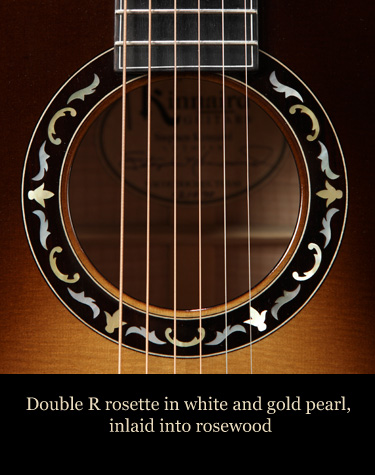
A Kinnaird Rosette

Attending the Guild of America Luthiers Convention was definitely exceedingly rewarding for me. Not only I have learned abundantly, I have met some luthiers who have become my friends. Stephen Kinnaird is one of them. My first encounter with a Kinniaird guitar was at Jeffrey Yong’s workshop. He showed me a Kinnaird guitar and the experience was impressionable indeed.

Stephen and I. One of his masterpiece

With great delight, Guitaring Passionately presents an exclusive interview with Stephen Kinnaird.

Weblink: Kinnaird Guitars

About Stephen

1. Why make guitars?

The short answer is, simply, that I love them! I love their sound, their shape, and the fact that they are a joy to play. Also I love wood, the raw material from which guitars are built. 

So, guitar-making combines two things that really stir me. Plus, it’s hard to describe just how rewarding it is to finish an instrument, and then play it. To go from raw materials to music is magical!

2. Can you make other stuff too?

I assume you mean other musical instruments? Our shop also builds electric guitars and mountain dulcimers. Plus, we have some interesting things in development, like ukuleles, baritone guitars, acoustic bass guitars and even harp guitars.

3. Where did you train?

I am largely self-taught. Much reading, experimenting, and talking to other luthiers who were also trying to figure these things out. I have benefited greatly from the advice and help of mentors and colleagues who have been happy to pass along their understanding of the craft.

4. What influences you?

Anyone who practices a craft draws inspiration from as many sources as possible, so a lot of things influence me. First would be tradition. I love the old Martin guitars of the late 1800’s to early 1900’s. There is an honesty, an integrity in their work that I find compelling. That is the “sound” that I work toward. However, I also love a good bit of today’s modern approach to lutherie, especially in the area of aesthetics. Rosettes, purflings, inlays—there is so much creative work going on in these areas now that I find liberating. What some luthiers are doing today is stunning. Fred Carlson, Steve Klein, Jeff Elliott, these guys and a host of others both influence and inspire me.

5. How long has it been?

How long have I been a luthier? I first became interested in lutherie in 1972. This came about by meeting a man by the name of Jay Rhyne. He was the first luthier I met, and he was a real inspiration to get started. I learned as much as I could, while finishing college, and managed to do some repairs and build some dulcimers. The first guitar was built in 1980, so this year marks 32 years as a guitar maker.

6. Was there a time(s) when you wish to stop?

What a question! There were some times when I had to stop, for various reasons: school, work, church. But the only times I wanted to stop were those times when I was disgusted with myself and the flaws I was making. Lutherie is quite demanding, and there’s nothing like making a musical instrument that will reveal your own flaws to you. Those are the things one has to press through in order to improve—not just as a luthier, but more importantly as a person.

About Kinnaird guitars

1. Are your guitars works of an artist, scientist or craftsman?

Another good question. I like to think that all three elements are there, combined in each guitar we build. There has to be the artistic vision, then the scientific reality if the thing is going to work, and then the craftsman has to roll up his sleeves and build the guitar. Each aspect is essential, and in a successful instrument all three areas blend happily.

2. What is unique about your guitars (work)?

With so many people building guitars now, it’s difficult to be truly unique. And, it is a goal of ours not to be different just for the sake of being different! However, each guitar is a reflection of what we love, and our own sense of style. In our design aesthetic we are fairly traditional. But we do enjoy working with alternative species of wood, and endeavor to combine our wood choices very carefully. Some of our shapes are originals, as is our peghead design and logo. So I like to think that a Kinnaird guitar is recognizable, that it does stand apart.

3. What guides you during the making process?

Love of the guitar, first and foremost. Then, the realization that what we are making is a musical instrument. By that I mean that precision in every step is essential. A flaw at any point of construction can yield unacceptable results later. Next, the understanding that the factories can turn out guitars so much more quickly, at such a lower price, our work has to excel.We have to deliver something that a factory just can’t, or won’t.

4. The most difficult part(s) is…??

a. If building for a client, fully accomplishing their every wish. Interpreting and expressing in wood what is to them, at first, only a dream or a sound in their head.

b. If building a “spec” guitar, designing something that has the broadest appeal, while remaining true to our own vision.

Let me add that these are the most rewarding aspects as well!

5. Is there a Kinnaird voice in your guitars?

Indeed there is. Of course body size/shape and wood choices will yield predictable results, altering the voice in definite ways. But through it all, our guitars sound like our guitars. It is a sound I love: large, warm, musical.

All pictures are taken with kind permission from Stephen Kinnaird Guitars' website

-End of Interview-

Saturday, December 17, 2011

Guitar Store LAUNCHED!

This is likely to be my shortest posting ...

The background to Guitar Store is all about guitar lovers and collectors. Through years of acquaintances I have come to meet guitar lovers of all shapes, sizes and colors. I am really fortunate to meet them and also their guitars. Even more so, some of them have entrusted me with their beloved guitars in repairs, restore and sales as well. For all these, I thank the Lord for His blessings ...

Singapore being a small country but the brand presence of exquisite guitars is certainly not small by any measure. Numerous pre-own guitars can be found on the local forums or classified advertisement medias. The pre-owned guitar market prices are much more competitive than the brand new ones. This has given opportunities to many guitar lovers to get their hands on their "dream guitars" that would have been otherwise unreachable.

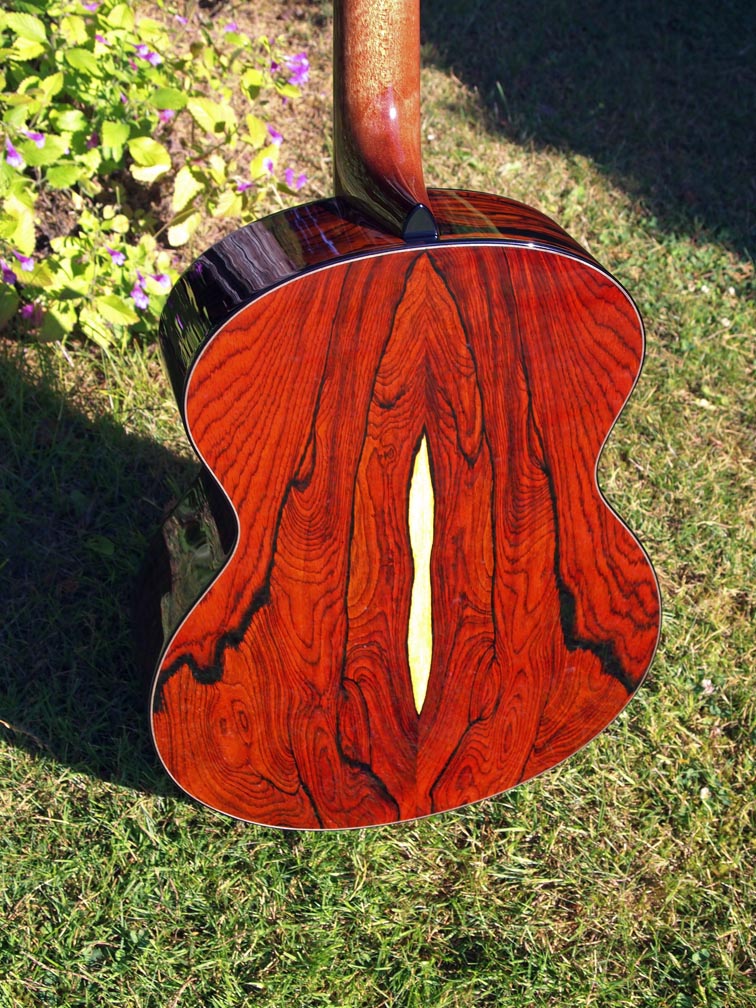
A Kent Chasson Built, Cocobolo Back/Sides
Taken from: http://www.chassonguitars.com/images/adam/74_back2.jpg

Over the years, I have witnessed many fine guitars being placed on sales ad. They come and go pretty fast. It might be logical to think that good branded guitars will move fast but ... there are a myriad of factors that can enhance or diminish the sale opportunity. Here are a few I have personally learned through experiences that can lower the chances of a successful sales.
  1. Inadequate or inaccurate written information
  2. Unrealistic price point
  3. Poor visual quality
  4. This is a subjective one ... attitude of sellers and buyers
The Guitar Store is set up to sell guitars of course. However I think that taking good pictures of these lovely guitars is just as importance to other success selling factors. More than often, well taken guitar pictures can give hours of viewing pleasure to guitar lovers. It is not unusual for guitar lovers to kinda ogle at beautiful guitar pictures found in the internet.

Sell or not is one thing but I believe good pictures can accentuate the true beauty of each well-built guitar. It is only fair to the Luthiers who have built these guitars to put in adequate effort in capturing the beauty in still frames. While I have done my level best to capture the best sides of the guitars showcased in this store, I am no professional in photography. If you find my shots are not comparable to your personal liking, I apologize herein in advance. You're welcome to drop comments in my blog so that the pictures can become better over time.

I hope my blog's Guitar Store can become one of your frequent visited websites to view beautiful guitar pictures. If things get sold, it is a big bonus to me ... certainly to the willing buyers too.

Visit the Guitar Store by clicking: http://cadam7777777.blogspot.com/p/guitar-store.html

Wednesday, December 7, 2011

Singapore Guitar Show Dec 2011

It was backed … two days at Suntec City, a display of various brands of handcrafted guitars, both local and overseas, to the local guitar community; it is the Singapore Guitar Show 2011 (http://www.singaporeguitarshow.com/current-edition-2011/press-release-2011/).

Day One of the Singapore Guitar Show

Tien Chor who volunteered to help

Playing guitar can be seen as a life long learning journey because nobody can claim full mastery. In this journey, we learn abundantly from any available knowledge sources that bombard us. We picked up both facts and myths as we learn more about guitars. With the internet, we can learn almost anything we can conceive of. While the information is easily accessible, the downside is the authenticity of it. Regardless if it is conscious effort or not, we learned from these many sources. Internally, we exercise personal evaluation on the information obtained or granted, and draw conclusions. By this process, we grow in wisdom and discernment. Did we? I had numerous interactions with the people at the show. Interestingly, it has prompted these thoughts; in any given learning settings, the absence of truth is quickly filled with assumptions. The assumptions solidified over time and when left unverified, they turned into pseudo facts … reversing these pseudo fact has proven to be difficult.

This observation was most interesting to me in the show. I think everyone has experienced it before. However, only some grew out of it. What might interest you at guitar shows?

In this posting, I try to do away with introducing every guitar maker, as it may be repetitive to do so. Instead lets’ discuss the interesting perspectives gathered from the people who turned up for this show. Anyway, I helped Terence Tan in organizing the show this year whereas I was an exhibitor in 2010.

These are the perspectives I have gathered ...

Heavy guitars, what about them? It was a common myth surrounding heavyweight guitars. It appeared that lightweight guitars were assumed to be good sounding guitars. While some guitar makers have consciously tried to reduce the weight of guitars, it wasn’t directly linked to tonal properties. Without a doubt, lightweight guitars were easier to handle. However to conclude that heavyweight guitars were less superior than the light ones were clear evidence of one’s failure to understand the principles of guitar construction. Invariably, to think that lightweight guitars will automatically produce good tone is all but truth. The great number of such claims I heard from the show participants didn’t surprise me.

Anyone who handles a Caldersmith guitar (http://www.caldersmithguitars.com/) will immediately feel the weight of the guitar. It was comparable to the weight of a regular electric guitar. If one stuck to the myth, such guitars will be disqualified before they have any chances of showcasing their potential. The weighty feel of Caldersmith guitars were indeed unusual because most classical guitars are lightly built. For centuries, many luthiers learned from one generation to the next. I suspect the notion of building lightweight classical guitars was linked to the perceived social value of classical music. Caldersmith Guitars produces such lovely tone that resembles birds’ singing. The classical guitars were not only well made; their loudness was surely amazing. The saddle was sloped which unliked the regular classical guitars where the saddles were flat straight. A Caldersmith feels nothing like a classical guitar until you pluck the first note. When that note travels to one’s ear, the thick, mellow yet defined tone will immediately eliminate all doubts.

Caldersmith Guitars

The lovely ladies behind Caldersmith Guitars and I

Jeffrey Yong’s guitars (http://www.jeffreyyong.com/luthier.html) are heavily built because his design principles of the soundbox were base on loudspeakers’ cabinet design. Well designed and built speakers were usually heavy in weight except for the new age designs type, e.g. Bose’s jewel cube speakers. Suffice to say that hi-fi enthusiasts will go for heavy speakers when given the options. In 2006, Jeffrey built a Monkeypod wood guitar and participated in a blind-listening guitar contest at the Guild of American Luthiers Convention 2006. It was heavy and unlike the conventionally built acoustic guitars. His entry has beaten all other guitars to emerge as the winning guitar. Since then, Jeff’s guitars have established their identity. By this measure, weight of the guitar was certainly not a determinant factor to quality as assumed by many.

Jeff and Rod

Jeff's collection

Steve and Jeff, both are happy men

Good materials make good guitars. Learning this notion was very common during the junior phase of playing and learning guitars. There were abundance literatures written about suitable woods for guitar building in the internet. However the commonly featured woods come from temperate regions and certain endangered species. As scarcity sets in, also due to excessive commercialization, it drives the prices of such materials upwards. As a result, the market prices of guitars made from certain rare or restricted woods increased tremendously. It is 101 consumer psychology; an exorbitantly priced guitar can’t be a bad one. There was another subjective factor that influenced the way we perceived the quality of a given guitar regardless of price, built and tonal properties, i.e. our personal preference. While this may cast doubt in every guitar’s worth but the assumption of good materials equal good guitars were overwhelmingly pervasive among guitar lovers. Therefore it was almost an instant agreement among guitar lovers to related good sounding guitars to good materials used. The presence of many guitars in the show have helped to debunk this myth.

Unshakable Perceptions; an ostrich that has its head buried thinks it is safe. Nothing can be further than the truth. The influence of literature was strong enough to convince many luthiers that instruments building woods were limited to a few species. Some have totally ruled out any woods not found in the commercial suppliers’ catalogues. Won’t we hear similar guitar tones regardless who builds the instrument as a result of such fixations? Some guitar makers will never use certain type of woods because they simple don’t believe in them … or such luthiers don’t believe in himself or herself? Guitar construction principles include selection of wood but it was not the prime principles of consideration. Instead attaining the mastery of the art and science in controlling the stiffness of the sounbox have greater significance than the frantic pursuit for the rarest wood on this planet. Before Jeff won the blind-listening guitar contest, nobody has heard of Monkeypod wood and much less to use it for guitar making. In fact many luthiers have explicitly undermined Jeff’s practices in using tropical woods. It table has turned after 2006.

Pushing the Boundaries. Classical guitars making was always guided by traditions. Any deviations from the advocated ways were strongly discouraged. However creativity is alive and it wants to change things. I met Rod Capper (http://www.capperguitars.com/) in this show. A great guy and he builds classical guitar. Immediately I noticed the elevated fingerboard in his guitar design. He shapes a piece of wood into a wedge and glued it between the neck and the fingerboard thus elevating the fingerboard (see picture). It improves playability by leap and bounce, noticeable sustain was achieved as well. However this feature was all but traditional … but his passion for building better guitars has overwhelmed the shackles of tradition.

Rod Capper and I

The elevated fingerboard design

A Rod Capper Classical Guitar

A Rod Capper Classical Guitar

In my best effort to illustrate the guitar show through this posting, I may miss certain exhibitors. Please accept my sincere apology in advance. Maestro Guitars has again showed their presence in the show. The guitars they have showcased were quality stuffs. The look, feel and tone of Maestro Guitars have surely progressed tremendously over the years. Worthy Guitars from Australia participated in the show for the first time. The man behind Worthy Guitars is David. A great guy to exchange ideas with and his guitars were very well built with great details and refinement. Another Australia guitar maker Scott Wise was also here for the first time. He has Ukeleles on display as well. Three handcrafted guitars brands came from Indonesia. They are Secco, Suwig and Prim’s Guitars. It was indeed the show’s honor to have their participation. Parekh Exports brought for the show a selection of instrument building woods. Not forgetting the local retailers that have faithfully supported the show, they are Tomas Music, MusicArk and Awe-In-One guitar picks. The show wouldn't been possible if not for the passionate support from Altas's team (http://www.atlasexperience.com/bose.htm) who has provided the wonder BOSE sound system for the performance segments. Thanks to Bobby, Wee How and Sean, they are wonderful to collaborate with.

This show has allowed me to meet new friends who are liked minded. I must say it was very rewarding for me personally. During the show, I have shared an invention of mine regarding dehumidifying of guitars. The responses were very encouraging. I received not only their attention, they freely gave their thoughts, suggestions and ideas in helping to augment the invention. I now look forward to the next show and also the progress of my invention.

Here’re more pictures

MusicArk ... Lance is setting up

David, the man behing Worthy Guitars

Suwig Guitar, Indonesia

Secco Guitar, Indonesia

Prim's Guitars, Indonesia

Maestro Guitars ... surely from Singapore

Tomas Music

An overseas performer

David and I
Thanks for reading!

Tuesday, October 19, 2010

Seeing China, Feeling China

The Music China Expo has certainly established China’s position in the world in manufacturing of musical instruments. It was held from 12 to 15 Oct 2010 where the day one and two were for traders and the remaining days were for everyone. There are hardly any musical instruments China is unable to produce let alone to imitate. Broadly, I will share my take on China’s musical instruments’ scene from a few perspectives. They are,
  1. Quantity versus quality
  2. Manufacturers’ maturity
  3. Consumers’ perceptions and behaviors
I will kick off with quantity versus quality AND manufacturers’ maturity. It would be unrealistic to mutually exclusive these two perspectives when discussing the music scene of China. In the Music China Expo handbook or any given trade shows' handbooks, one will find a list of exhibitors organized in various formats but the most common one is in alphabetical order. After flipping many pages of the Music China Expo handbook for 10 minutes, I have seen nothing but Chinese companies. As many retailers I could see in the list, there were as many manufacturers. Although there were a few foreign companies but it was a far cry to be compared to the sheer numbers of Chinese companies. These companies mean business. They spare little manpower and resources in creating an impression to the others. The visual identity of each company or brand is evidently created and displayed. It is easy to agree that budget wasn’t the prime consideration. In Singapore, we lament about walking about the Singapore Changi Expo halls because of the distance and space. By this standard, we should contemplate driving within the expo halls of the Music China. Huge is an understatement … As the saying goes, you build them and they will come. The expo halls are built BIG for the BIG crowd.

Here’re some pictures to illustrate the magnitude.

Expo main entrance
This is a common sight everyday
Mass registration or Mess registration?

Pictures were taken in the early morning and I just wonder how much crowd can be built up by late morning. Hann and I took a picture (below) outside of the expo hall. The light poles behind us are still within the expo premise.

Hann and me

Another picture taken to illustrate the size of this place.

A panoramic view, the place is HUGE! 

As you gather from the pictures above, the expo centre is a purposefully built facility to handle events of mammoth scale, arguably at world's scale. By default, the number of exhibitors and visitors also flocked in by great numbers. Does it imply with great numbers mean high instruments’ quality? In mathematical perspective, it does make sense to assume the former statement to be true. However it was neither a flat NO or a resounding YES. Things are hardly black or white in China. I think you can appreciate this statement.

I was quickly dazzled by the sheer quantity of products displayed in the show. Promptly I walked through isles and halls to get a glimpse of the coverage. After the initial scan, I got into details. By conversing with the exhibitors and scrutinizing the instruments, it was apparent that they were more eager to sell the products than to emphasize the quality. Cultivating customers’ loyalty was not the prime concern too. There were a few smaller players that were very service-oriented but their influences were insignificant against the masses.

The guitars were made with quality and suitable tonewoods, much like those made in North America, Japan and Europe. Distinctively, the quality of the fine details of the China made guitars differ from the mentioned three countries. Less attention was paid to achieve those intricacies. Given the type of tonewoods available in China and the current product standards, the guitar manufacturers have yet to discern the many quality tiers among guitars, especially in these three major aspects; tone, appearance and playability. E.g. rosewood B/S guitars are regarded as good guitars regardless of the manner of construction. Matching the prices to guitars are as pragmatic as reading the specifications. The three major aspects were hardly in their awareness let alone consideration. This may also account for the lower in price range. By no mean that guitars made here are inferior. Lacking in ability was unlikely but maturity may be more appropriate. But I reckon China guitars will arrive to be recognized as quality products very soon. It was like the era in pre-world-war 2, traders shunt Japanese made products. After the war, Japanese products were elevated to world-class standards and traders started avoiding Taiwan made products. Now we have reservations with China made products. Soon we may treat India products the way China products were treated and what does mean for China products then?

Prices led the way in sales transactions. This is probably driven by the consumers’ perceptions and behavior. There were immense amount of curiosities among the consumers. While internet has kept the consumers well informed but they were not discerning in product knowledge and applications. In the show, Singapore brands were highly regarded by the Chinese because of the high standards of governance Singapore has shown to the world. It did indirectly elevate the brands from Singapore regardless the level of awareness they have on those Singapore brands.

In terms of guitar construction, the consumers were aware of the price differences between a full solid wood and laminated wood guitar. However it was not apparent that they could feel the actual quality. Invariably, it may be hard to convince them that a full solid wood guitar can sound like a dog whereas a laminated wood guitar can sing like an angel. They may also compare one brand to another without knowing adequately of both and draw their own conclusions. Does all these still happen here? I highly think it does … are we so different after all?

Given the huge population in China, it is acceptable that they need time to develop and attain progression in the people. Unlike infrastructures, they can be built in the shortest possible time but wisdom that comes with maturity takes time. Very soon, there will be no avoiding of China made products and they are here to stay.

Enough of writing; the pictures galore starts from here! Enjoy them.

One of major retailers
Takamine Guitars
Ibanez Guitars
Demonstrating products capability 
ZOOM in action
One of the many contract manufacturers
One of the many isles
Some instruments manufacturers
Sure you can find one that fits!
Drum skins for anyone?
Case Galore!
More Cases
Brass & Windwoods
Classical Chinese Musical Instruments
Cool looking amps
Seafood galore!
Amps don't look the way they used to
Performers for B-band
New acoustic amp from B-Band
Selecting tonewoods
They are curious enough to try .. anything ...

Seeing and feeling China was indeed an invaluable experience for me. Those views were purely my personal expressions and anyone is free to contribute their comments.