Promotion Items

the KILN @Indiegogo
4hr Courses

Dear Friends, Guitaring Passionately has began its inaugural acoustic guitar making process in early 2017. Do stay tuned to the progress thru instagram and Facebook.

Check out our Price Busters

Learn practical guitar maintenance skills in our 4hr Courses. Brochure Download here

Thursday, March 8, 2012

Emerald Guitars and ArtMusicKitchen…

Guitars and Kitchen seldom mix…

Emerald Guitar X5-OS

A private dinner at ArtMusicKitchen

Guitars and Kitchens… they don’t seem to fall within a category. However ArtMusicKitchen (http://artmusickitchen.blogspot.com/) is all but just a kitchen. The idea was driven by two passionately individuals who love to eat, listen to music, play musical instruments and socializing. It is located within city precinct; it provides a cosy atmosphere for private parties to take place where food, music and fun are all gathered under one roof. It wasn’t unexpected for Emerald Guitars to find its way into this kitchen as well. Check out the video clip of a party below!


About guitars… it is common for guitar enthusiast to engage in discussions about guitar tone. Jargons like woody, deep, majestic, bright, sweet, etc. are commonly exchanged within these discussions. It is true that we are attracted to certain sounds whereas the unwanted sounds are being called noise. To simplify our already very complicated world, lets’ just call them good or unwanted sound.

Guitars are traditionally made from wood. It was almost a taboo to consider otherwise in the early days of guitar making. To build one successfully, guitar makers must possessed knowledge of an engineer, skills of a craftsman, and touch of an artist. Inadvertently, tradition ways have a big influence on guitar making even until today. Some people argued that guitar is timeless… therefore it should not depart from the traditional methods. However, time will change everything regardless.

Many guitar players have been educated that guitars should only be of wood base. It wasn’t like there were plenty of alternate materials and processes in the early days where guitar were created. If all you got are trees in your backyard, it might be obvious that this so called choice materials were actually founded on basis of abundance and accessibility. Imagine you live in Planet Timbuckto and there are only carbon stems in your backyard. Guess what you would build your house with?

One of the founders of ArtMusicKitchen has always wanted to play guitar even he is on the road. The many maintenance considerations of a regular guitar didn’t allow his desire to materialize but Emerald guitars did. He felt the full value of Emerald guitars after owning the X5-OS. The lifestyle of most Singaporeans may benefit from this guitar. Driven and excited, he contacted Emerald Guitars and before he even knew it, the shipment is confirmed and arriving to his doorstep very soon. You can find ArtsMusicKitchen on Facebook as well.

Below video clip features the Emerald X5-OS, Arthur's Theme played by David Ng. 


When I first played an Emerald guitar (http://www.emeraldguitars.com/products/guitars/), I had mixed feelings. It wasn’t obvious to me why it did. Only after a short moment, I realized that I was subconsciously expecting a “typical guitar sound” during my first test drive of it. Immediately I cleared my mind of any expectation and tried the Emerald X5-OS once more. The feeling was totally fresh and I could better detect the potential and merits of this composite material guitar. I could hear the bass, mid and treble with no problem. The balance was there and playability was great. So does it sound like a guitar with Appalachian Spruce Top and Brazilian Rosewood B/S? It was not about whether X5-OS can sound like a wood guitar. It didn’t need to plainly because it wasn’t made from wood.

Below video clip features the Emerald X5-OS, Scarborough Fair played by Tomo


A good sound is a good sound regardless it is traditional or modern. By the same token, Emerald guitars were built with a different point of view that happen to take the shape, forms and functional features if a guitar. Just because it does, should this guitar be trialed by a jury that only recognizes wood? The X5-OS is a compact and enduring instrument that is suitable for any roadtrip you would be embarking. Imagine strumming your favorite tunes while sunbathing.

Guitaring Passionately is honor to be appointed to provide guitar care for the Emerald Guitars. Drop ArtMusicKitchen an email (artmusickitchen@gmail.com) to test drive the Emeralds!

I will leave you to find more from my interview with Alistair Hay, the man behind it all, the creator of Emerald Guitars. Website: http://www.emeraldguitars.com/products/guitars/

Alistair Hay and his composite guitar

1. Tell us a bit about yourself. Before embarking on making graphite guitars, what were you doing?

I grew up working in the family business which was a composites and engineering factory. I was always interested in the composite side of the business and worked with composites every weekend and during school holidays. I then went on to study Polymer Engineering in College where my interest in composites and polymers was increased further.

On leaving College I got a job in the USA building formula one race boats for the Seebold race team and work closely with the world Champion Bill Seebold. This experience changed my life as I learned about high tech composite structures and carbon fibre. Bill became my mentor and inspired me to excel and find something that I could be the best in the world at.

After that I came back to Ireland and the seed that was sown started to grow into Emerald Guitars

2. Do you have any formal training in guitar building or prior experience in dealing with carbon fiber?

I don't have any formal training in this field. I started off by reverse engineering my own guitar and making lots of mistakes. I was determined to take a new approach and the materials I was using were so different from regular guitar building. I did however find a highly skilled local Luthier who guided me a little and helped steer me a little.

It was very much trial and error and from 1998 to 2001 I made about 50 guitars just to perfect my art. None of these left my possesion and most are screwed to the roof of my factory. I knew that It was going to take alot to make a guitar good enough to sell. Since then it has been a continual development and each year we strive to make guitars better than the year before.

3. Before carbon fiber, did you ever build traditional wood guitars?

No I have never built traditional guitars but over the years I have studied traditional wood guitar building and have learned a great deal about voicing and tone and reinterpreted these rules and applied them to composite construction.

Building with carbon requires a completely different approach as the construction methods are so different and you need to think about the materials in a different way.

4. Why carbon in the first place?

First and foremost I started with carbon because it was the medium I understood best. For me the guitars I build express everything I have learned over the past 25 years and it is a medium that allows me to utilise all my knowledge and skills to the maximum through materials, engineering structure and artistic expression. Working with carbon is so natural to me and I find it very liberating. Because of composites we can do things that just arent possible with wood. I would never say we will replace wooden guitars but in some areas Carbon is just soo much better. 

5. How did Emerald Guitars start?

I first started building guitars in 1998 as a hobby but soon after I realised it was what I wanted to do for the rest of my life. The name Emerald Guitars came into existence in 1999.

Creating

6. I understand Emerald almost went under some years ago. What happened and will it happen again?

We had worked closely with Parker guitars and agreed a deal to use their unique fret board. It was great for a few years but then Parker was sold over to US Music and soon after without warning they stopped suplying us. This left us over night with no fretboards to complete orders and no way to create income. The Parker design is very different to conventional fret boards so we couldnt source a replacement without significantly modifying all our moulds. This was a challenge we couldnt afford to meet and put us out of business virtually over night.

I have since redesigned all our moulds and we now do everything in house giving us a much greater security and after this difficult event we have created a more secure business and a higher quality guitar as well. Its been a tough lesson but a valuable one.

7. Is there a typical profile of a Emerald Guitar buyer? What should a potential buyer expect from Emerald Guitars?

It continually surprises me how diverse our buyers are but I would say the thing the all have in common is that they judge our guitars on their merits rather than preconceived ideas of what a guitar should be.

We strive to create inovative products of high quality that allow musicians to express their music in a new way and give them the freedom to enjoy playing guitar without the worry about weather and climate effects.

8. What's the greatest reward you get from Emerald Guitars?

The greatest reward is to hear a musician play music that was inspired on my guitars and this in turn inspires me to build guitars. Its a perfect symmetry of give and take.

9. Share with us, if you will, some of your musical influences.

From a very young age I have been fascinated by guitars and any music containing lots of guitar. In my early years it was Dire Straits, Queen, BonJovi, Metallica, Black Sabbath etc.. then I went to college and a friend gave me a Steve Vai album. I had never heard solo guitar like this and it transformed me and led me to buy my first guitar 2 weeks later. That opened a world of solo guitar players to me such as Joe Satriani, Yngwie Malmsteen, John Petrucci, Paul Gilbert and acoustic players such as John Williams, Paco De Lucia, Pepina Dagostino, Eric Roche and Andy Mckee.

Music is the source of my inspiration and its been so amazing to have been able to build guitars for some of my influences and its been beyond my wildest dream to have built 3 guitars for Steve Vai, one of which he has used in his upcoming album.


10. You’ve already documented how your friendship with Wang Leehom came about (http://www.emeraldguitars.com/custom/the-art-of-guitar/bahamut/). What about your link with Singapore’s very own Tay Kewei?

I first met Tay Kewei when she was performing as a backing singer with Leehom in Malaysia and then we met again in Beijing. I really admired her singing and she was looking for a new guitar that suited here style so we built an X7 for her. She really loved its compact and comfortable proportions and the great tone she could achieve during performances with it.

- End of Article -

Wednesday, February 29, 2012

Saddle Materials For Guitars Part 2

Due to some technical errors, the previous posting has been deleted. This is a repost

Walrus Ivory Nut
Walrus Ivory Nut

Part 2 is expected to be slightly technical… While I am aware that not everyone will enjoy reading technical stuffs, such information does provide both wider and deeper comprehension of saddle materials in relation to tonal characteristics. This can further narrows the subjectivity tendencies in selecting the suitable saddle materials to match one's preference. During my study on saddle materials, I have reviewed several literatures written by anthropologists and other researchers that have conducted extensive study onto these materials. The sources are attributed at the end of this posting. For those who wish to know more, you're encouraged to read those resources. Herein I will attempt to elaborate the ever elusive saddle materials and tone from these perspectives.
  1. Brief introduction of Acoustics
  2. Acoustic properties of materials
  3. Properties of the various saddle materials.
  4. Sound clips - Bone and Ivory
About Acoustics

Particles transmitting vibration energy

Firstly, we all know that sound is produced when an object vibrates. The vibration pushes surrounding air particles, and these particles oscillate which spreads like ripple effects, the oscillation gets passed on between adjacent particles until the initial vibration energy is completely dissipated. Our ears detect such particle movements as sound. Guitar saddles function to transmit strings vibration energy to the guitar top plate (wood) resulting the vibration of top plate. We hear guitars through this energy transfer process. However energy loss is inevitable during the process of vibration transfers. Saddle materials are no exception to that. Perhaps it could very well be due to the inherent energy loss for each material that is different from others that sets each apart. While sound energy can be transferred via various mediums, this article concerns saddle materials, which are solids.

About Acoustic Properties of Materials

Many properties affect the eventual acoustic properties of any given materials. Herein I am featuring three prime properties in determining if a given material transfers sound energy or absorbs it. Understanding it is essential to predicting the tonal characteristics of saddle materials. However, there is no attempt to rank these featured saddle materials.

The three properties are density, rigidity and porosity.

1. Density - a measure of mass per unit volume of material. Dense materials allow efficient transfer of sound energy. Low density materials tend to absorbed part of the sound energy in making the particles within the material to vibrate.

2. Rigidity - a measure of resistance to deformation by external force of a given material. Malleable (Non-Rigid) materials can absorb sound energy in making the particles within itself to vibrate, which is similar to low density materials. Conversely, rigid materials can transfer sound energy through their material structure with little loss.

3. Porosity - a measure of the quantity of empty spaces (air gaps) in the total volume of a material. This is the most tricky property of the three. For a highly porous material, it is made up of very dense and rigid molecular structures. Adjacent to these dense and rigid molecular structures are air voids, too small to be observed by naked eyes. Rigid molecular structures promote efficient sound energy transfer with minimum absorption (loss). However the air voids within have created changes of energy propagating medium from solids to air voids (a.k.a. changes in surface impedances). This isn't good for energy transfers if the path way is subject to many impedance changes. Invariably materials of low porosity doesn't guarantee superb sound energy transfer because density and rigidity must promote it as well. Suffice to say that the relationships between porosity and efficient transmission of energy is far more complex.

Those who wish to read on, the following sections will cover the various saddle materials widely used in the present market. I have made no attempt to do any review but report the researched and known facts related to each featured material herein. There are unlimited literatures on this topic and my version may not align with many others. Also please don't take my writings wholesale, be curious to verify and even recommend corrections. In this way, everyone will learn and hopefully inclining to greater accuracy in creating such literatures. The following saddle materials will be featured in the next few sections.

Plastic (Synthetic)
Synthetic Ivory (Synthetic)
Pyrolytic Carbon (Synthetic)
Brass (Alloy)
Bones (Natural)
Horns (Natural)
Ivories (Natural)

Synthetic Materials

1. Plastic - Actually it is a by-product of crude oil refinement process. Polyethylene a.k.a. plastics have surely changed our lives. Its versatility has made it relevant. One such application is the injection molding process. Just about any plastic you hold in your hands is made through the molding process. By going in large volume, plastics products can achieve speed in production, volume in production, consistencies and most importantly reduction in cost per plastic product produced. While there are various grades of plastics, they are pretty much viewed by laymen as similar.

In making guitar saddles, the moldable nature of plastic has overwhelmed all other materials regardless of their merits. Just about any shape can be made out from plastics. As such, plastic saddles of any kind are seen flooding the guitar markets relentlessly. A huge attraction to guitars manufacturers indeed. In terms of properties relating to acoustic qualities, due to plastics' general low rigidity, it will be hard to claim that plastic saddles can enable a guitar to fully express herself. The density and rigidity of plastics are usually not close to regular natural materials like bones, ivories and horns. While these two attributes are main influences to acoustic properties of any given materials but they are still not the determinant ones.

It is also difficult to describe the tonal characteristics from plastic saddles except to predict more sound energy loss is expected. Suffice to say that changing to harder and denser materials with known acoustic properties, improvements are noticeable immediately. However plastic is here to stay regardless..

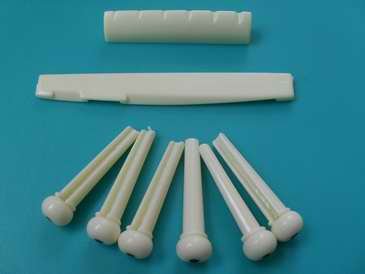
Plastic parts

2. Pyrolytic Carbon - it is a diamond like carbon base synthetic material that has undergone a treatment process call pyrolysis. The treated materials are enhanced in certain mechanical properties. The patent of this process is held by James M. Guthrie and Jonathan C. Stupka, both are based in Austin Texas, USA. The company behind the development of this material is Obbligato Inc. also based in Austin Texas, USA (http://www.obbligatoinc.com/).

Elaborated in the patent, pyrolysis is inducing decomposition of hydrocarbon at temperature in excess of 1000˚ C. In this state, carbon molecules can be coated on a suitable substrates of dense isotropic graphite, also of suitable size and shape which include various guitar parts. The coating can be of structural or surface nature. The process in which they are made will likely result in increase in rigidity and density but porosity is not conclusive. This carbon base material bears a trademarked name "Black Diamond" because of the way the material is synthesized. These are the claims regarding tonal and functional enhancements for applications to musical instruments.

≈ significant increase in volume
≈ gives richer harmonics
≈ clearer sound, reduce muddiness
≈ strings sound lively for a loner period before going "dead"
≈ gives strings coming to contact with such materials longer life-span

Pyrolytic Carbon a.k.a. Black Diamond
Taken from: http://www.obbligatoinc.com/images/Saddle_FV.jpg

A Black Diamond Saddle
Taken from: http://www.obbligatoinc.com/images/DiamondSaddlecrop.jpg

Source: Pyrolytic Carbon Components for Stringed Instruments Patent, USPTO # is 8,110,729.

I wasn't able to obtain any empirical data to verify the above claims but given the method which it is synthesized, the Black Diamond is likely to give any organic material a run for its money.

Clarification; the above section has been amended from synthetic ivory to pyrolytic carbon. Factually, it is incorrect to classify pyrolytic carbon as synthetic ivory.

3. TUSQ, a material well known to many guitar players, also widely called man-made ivory, is produced by Graphtech, a Canadian company. Graphtech has employed this patented TUSQ technology for more than 30 years in producing many guitar parts. TUSQ has similar enhancements as claimed by the pyrolysis process. Likewise I wasn't able to find any empirical date to support those claims. However the popularity of TUSQ has certainly been established strongly among musicians. Anecdotally, one may find it hard to deny its qualities by the sheer popularity.


3. Brass - it is an alloy of copper and zinc known for its superior acoustic properties. This wonderful materials carries many favorable properties that have magically fitted into man's evolution. As man became more knowledgeable, the application of brass also widens and deepens. Its great versatility in industrial and commercial applications has made it indispensable.

Brass nut

While many musical instruments are made out of brass, it is not known if it was the malleability or acoustic properties of this materials that made brass the top choice for making metal musical instruments, perhaps both characteristics have contributed. As for acoustic properties, brass does carry certain properties like strength, elasticity, density that are favorable to sound energy transfer too. There are other metals that possess similar basic properties but they don't make the grade of musical instruments. The history of brass in relation to metal musical instrument is indisputable. Brass saddles are rare but nuts are commonly seen.

Natural Materials

The next sections, I will provide a simplified summary of each natural saddle materials. Instead of focusing on merely acoustic properties and tonal qualities when applied as guitar saddles, understanding the fundamental make up will help in making sense of the tonal characteristics of these natural saddle materials when in use. After all, acoustic properties of any given materials are all but an extension of their fundamental make up.

Bone parts

4. Bones - It is a dense type of connective tissue made up of 1/3 organic tissues and 2/3 inorganic salt components. This wonderful substance provides functions like support, protection, movement assistance, mineral storage, blood cells production and chemical energy storage. Porosity and density of bone are not uniform for all bones. It is because of the unique functional applications of various bones located at different body parts that render its variable porosities and densities. Besides the structural function undertaken by our bones, blood irrigation is one of the many essential functions as well. This explains the porosity nature of bones.The bones for making guitar saddles are compact bones that has the mechanical and acoustic properties to meet the expectations.

Horn saddle

5. Horns - It is composed of a sheath of keratin overlying a bony core. Keratin is a class of resistant and insoluble fibrous protein. These keratin tissues are usually associated with various essential biological functions e.g. offense, defense, display, communication, temperature and water regulation. In fact, there are other body parts which constitute keratin tissues as their make up, e.g. feather, hair, claws, nails but in this article, the feature item is bovid horn. It is not regenerative unlike nails or hair. The growth of horn is also made possible because of the presence of organic tissues which deliver nutrients and minerals to it. Unique to bovid horns, moisture content within can have significant influences on its overall strength.

FMI Nut
FWI Saddle

6. Ivories (Elephant, Mammoth, Mastodon, Walrus) - It is a calcified substance which possesses a complex chemical and structural composition. In material science terms, ivory is a rigid biological composite, has a rigid matrix reinforced by elastic fibers. Its strength comes from calcium phosphate found in the rigid matrix and its elasticity is due to discontinuous collagen fibers. The application of tusk (before they become ivory) during their active days include functions like pushing, piercing, bending and bearing its own weight. The make up of ivories is also like bones or bovid horns consist of both inorganic and organic tissues. It is almost made entirely of dentine, coated with a layer of cementum. Within the dentine core, pulp cavity takes up about 1/3 of the entire tusk length, beginning at the pulp rostral. The growth of tusks are enabled by the delivery of nutrients and mineral via the dentine pulp.

Tonal Characteristics

The above three natural saddle materials are found to be dense in general. Each one possesses high strength and elasticity due to the functional requirements during the active days of each. It may not be squarely considered as a rigid material nor soft as well. Within each one, it is made up of both organic and inorganic constituents for its initial growth years. The porous nature of each enables nutrients irrigation thus growth is possible.

In relation to the tonal characteristics of each material, it is all about recognition and differentiation. This is also the main issue. The process of recognition and differentiation is all but a subjective preferential cognitive process. Far from perfect but this is what we have. Not withstanding our subjective preferences, each material does carry it unique characteristics that are influenced by the fundamental make up, density, rigidity, strength and porosity. As objective and factual as I can, below are my two cents of each material, largely base on my experiences in working with them and the data table below.

Data Table

Bones are denser than ivory (see above table), thus also heavier for a given unit of volume. In terms of rigidity, bone has higher Elastic Modulus than ivories which accounts for its stiffness and hardness. Taken from Maury Music's website on saddle materials' review, "Bone saddles offer very pure tone, nice volume and an increase in sustain…" I interpret pure tone as loud, clarity and unaltered. What is yours? In relation to bone's acoustic properties, its high density and rigidity are likely contributive to the tonal characteristics. As for porosity, it is inconclusive.

Ivories, the common ones use in acoustic guitars are Fossilized Mammoth, Fossilized Walrus and Elephant. Compared to bones, usually their densities and rigidities are less but not far from it. However ivories are known to be tougher than bones in terms of fractures, i.e. high in elasticity strength. While bone is observed to give pure tone, ivories tend to influence the tonal signature of guitars. Taken from Maury Music website on saddle materials' review, "They add warmth and fullness, fatting up the notes and compensating for any brittle qualities one might hear…" and also " If there is a downside to fossilized ivory it is found in highest highs. Some of the brightness and sparkle, what I call the angels in the harmonics over top of the voice, is sacrificed in exchange for that added warmth and meat in the undertone and fatness in the fundamentals."

The link to Maury Music's saddle review article: http://www.maurysmusic.com/fossilized_mammoth_ivory_saddle___todd_s_review

We can loosely conclude that ivories are softer than bones because bone fractures more readily than ivories. In a paper written on the physical characteristics of mammoth ivory (Heckel C., 2009), bone specimens when subjected to percussions by hammerstone fractured. Whereas ivories were able to take more blows and cracks were seen propagating before fractures finally set it. This amazing property is indicative of ivories ability to absorb mechanical energy. Personally, I think this unique ability has resulted in the tonal distinction mentioned in saddle materials review article.

Here are two audio clips for your listening pleasure. The only difference between both clips is the saddle material. Here is the recording chain regarding the clips. Remember to raise your device volume if you can't hear the clips optimally.

Guitar: Gibson Western Classic
Mic: Zoom Q3
Amplificaton: Unplugged
Instrumental Tune: 31-91 by Hardline
Clip one: With FMI saddle
Clip two With Bone saddle


What is your take?

Buffalo Horn Saddle

Bovid horns are least rigid compared bones and ivories. In handling the blanks, they can be readily bent, unlike the stiffness of bones and ivories. However, bovid horns' are still considerable stiff, tough and strong because of the functional demands of horns. Hydration significantly affects the stiffness. Water penetrates the intertubular matrix, acting as plasticizer thereby reducing density and stiffness of bovid horn. Well in laymen terms, horn feels softer. Sound energy transfers 101, more sound energy loss is expected from bovid horn materials. When translated to tonal characteristics of guitar, one would expect less volume but the other characteristics are anyone's guess.

Brass possesses higher levels in strength, rigidity and density than all natural saddle materials. Moreover brass's acoustic properties are indisputable. When used as guitar saddles, the heavy weight is expected to increase sustain, boost clarity and volume. However, it is harder to make a brass saddle by hand than those natural materials. It might be this practical reason that brass is not commonly used as guitar saddles.

Closing

My conclusion is similar to part 1 in essence. While we can put in tremendous effort in quantifying the properties and normalizing the way we describe the materials, there is no escaping from our preferential judgment on such intrinsic attributes. There isn't much difference in loving someone where it is all in the eyes of the beholder. In my effort to condense the abundance of literatures that are related to the topic of saddle materials, I hope this article is able to provide fresh angles and insights to all guitar lovers. To some individuals, judging should be solely base on irrefutable facts and data whereas on the other end of spectrum, some individuals are totally comfortable in using subjective perspectives, jargons and intuition. Part 1 has given attention to subjectivities and part 2 has attempted to link mechanical properties and acoustic properties of various saddle materials to the eventual tonal characteristics of guitars. If you are able to find your preferred tone and saddle materials after reading this article, it would be the greatest reward for me. It was indeed an interesting ride for me. Thank you for reading!

Sources

Acoustic Properties of Materials: http://www.crecim.cat/portal/images/MaterialsScience/public/Acoustics_module_3rd_version_en.pdf

Measurement of the Acoustic Properties of Acoustic Absorbers: http://www.inceusa.org/nc07/links/Muehleisen_plenary_acoustic_properties_materials.pdf

Bone Structure and Composition: http://www.eng.tau.ac.il/~gefen/BB-Lec1.PDF

Tensile Properties and Facture of Ivory: http://www.springerlink.com/content/l3112460j86446nx/

Physical Characteristics of Mammoth Ivory and their Implications for Ivory Work in the Upper Paleolithic: http://www.urgeschichte.uni-tuebingen.de/fileadmin/downloads/GfU/2009/071-092.pdf

Experimental study on the mechanical properties of the horn sheaths from cattle: http://jeb.biologists.org/content/213/3/479.full.pdf

Classical Guitar Forum thread about nut and saddle material: http://classicalguitar.delcamp.net/viewtopic.php?f=11&t=61655&start=15

The effects of material in brass instrument: http://la.trompette.free.fr/Smith/IOA/material.htm

Acoustic properties of common metals: http://www.efunda.com/materials/common_matl/Common_Matl.cfm?MatlPhase=solid&MatlProp=Acoustic#Acoustic

Physics of musical instruments: http://hyperphysics.phy-astr.gsu.edu/hbase/music/musinscon.html#c1

About brass: http://www.copperinfo.co.uk/alloys/brass/brasses-properties-and-applications.shtml#s3

Measurement of the toughness of bone: A tutorial with special reference to small animal studies: http://www.lbl.gov/ritchie/Library/PDF/bone_tough_bone_08.pdf

Structure and functions of bones: http://www.ivy-rose.co.uk/HumanBody/Skeletal/Skeletal_System.php

What is bone? : http://www.mananatomy.com/basic-anatomy/bone

What are cow horns? : http://www.cowboyway.com/What/CowHorns.htm

Structure and innervation of the tusk pulp: http://www.ncbi.nlm.nih.gov/pmc/articles/PMC1571488/

Microstructure, elastic properties and deformation mechanisms of horn keratin: http://www.rhinoresourcecenter.com/pdf_files/126/1263373670.pdf