Promotion Items

the KILN @Indiegogo
4hr Courses

Dear Friends, Guitaring Passionately has began its inaugural acoustic guitar making process in early 2017. Do stay tuned to the progress thru instagram and Facebook.

Check out our Price Busters

Learn practical guitar maintenance skills in our 4hr Courses. Brochure Download here

Thursday, April 18, 2013

Bite Size Tips 004B – Buzzing No More!


In the article 004A, I have featured string buzzing due to low string height. This one will discuss neck relief (resulted from neck straightness) instead. Before we proceed, string height and neck relief are two different attributes found on guitars. Don’t mix them up by assuming that they are the same thing. Lets’ begin by understanding neck relief, its meaning and functions.

There are a few ways to understand neck relief. Primarily it refers to straightness of guitar neck that resulted the amount of string clearance between the fingerboard or fret wires with the strings measured at 6, 7 or 8th fret. At least this is my comprehension of neck relief. It is essential to have sufficient neck relief because it governs string clearance, which in turn governs the tonal quality of guitars when played. Without string clearance, guitar strings will not have enough space to oscillate freely without being obstructed. This is one of the main causes for acoustic guitars sounding thin and choked.

Basically there are three types of neck relief situations.

1. Concave or “Bow” neck.
2. Convex or “Hump” neck
3. Straight neck

Below shows an image illustrating the three different situations.
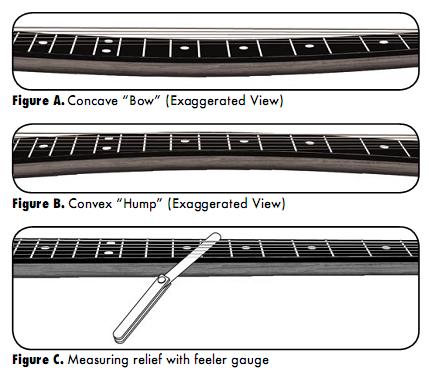

Taken from: http://www.rockwellguitarclinic.com/images/relief.jpg 

Fortunately most acoustic guitars are fitted with truss rod with their necks. The purpose of the truss rod is to add strength to the neck and also compensate any neck distortion. It does so by a compressive mechanism built into most truss rods where two different rods of two differing length are used to produce the desired “distortion” to counter the natural ones. See below picture illustrated the working principles of such adjustable truss rods.


Taken from: http://proguitarshop.com/media/cms/blog/trussrodadjustment.gif


Taken from: http://i779.photobucket.com/albums/yy77/unclefogey/trussrod.jpg

There were fixed truss rods used in the past. Martin Guitars has introduced the Martin T-bar in the xxxx. Truss rods of the like are mean to add strength to guitar necks so as to resist neck distortion. However the immense combined string tension will inevitably distort guitar necks over time. Below shows three different types of truss rod ends.


Taken from: http://www.fretnotguitarrepair.com/images/truss-rod/martin-truss-rods.jpg

String buzzing related to neck relief is caused by convex or hump necks. When guitar necks distort in the convex manner, the string clearance will be reduced. As long as this clearance is adequate, the guitar still plays decently but once the clearance tips too far buzzing starts to pop up. Is a perfectly straight neck the most ideal? I still hear debate over adopting a perfectly straight neck and slightly bowed neck. The bottom line is to allow strings to oscillate freely.

Below are two pictures showing desired neck reliefs.


Taken from: http://customguitarprojects.co.uk/wp-content/uploads/2011/08/gene_necks1-truss-rods.gif


Taken from: http://www.frudua.com/manuals/imgmanuals/figura6manicoin.gif

So how do you know how much is adequate? In most guitar technical manual, a range is always recommended as oppose to a fixed figure because this neck relief thing varies between guitars and also players’ preferences. In short, there is no one size fits all neck relief. Once has to trial and error to get the sweet spot. By knowing enough, the process of trial and error can be shorter and more effective than shooting in the dark. The picture below illustrates a way to estimate neck relief. Keeping the low E string fretted on 1st and 12th frets and use the middle finger to feel the amount of relief at 7th or 8th fret. You should feel a slight clearance between guitar string and fret wires. If a 100GSM paper can slip through this gap, the neck relief should be sufficient.


Taken from: http://www.fretnotguitarrepair.com/images/neck/checking-neck-relief.jpg

Nothing beats doing the real thing. After much talks about the rhyme and reasons, it is time to get our hands dirty. Adjusting truss rods has been a sacred ritual and only to be tempered by experts. Actually it isn’t that scary a thing. If you’re not comfortable in tempering your thousands of dollars guitar’s truss rod, do send it to a qualified person to undertake this task. Before adjusting the truss rod, make sure these things are in good order,

1. Nut and saddle are well set up, no issue with string height
2. Fret wires are not worn off excessively or uneven

It is essential to consider the above attributes because if they are the actual cause for string buzz, adjusting truss rod might be like barking at the wrong tree.

Here is a typical situation; after estimating the neck relief by hand you found that the neck relief was not adequate, or there isn’t any. You are about to adjust the truss rod.

Prepare the following equipment,

1. Truss rod wrench. It can be an allen key of socket wrench. Be sure to use the right tool as recommended by the guitar manufacturer.
2. Feeler gauge, name cards or a piece of 100GSM paper

Once you have fitted the truss rod wrench into your guitar properly, you are ready to turn it. By rule of thumb, you should always look at the truss rod end to determine the correct direction of turn (adjustment). The picture right below illustrated truss rod adjustment at the headstock. Since this situation is about creating more neck relief, you should be turning the truss rod anti-clockwise. Another words you are loosening the truss rod thus giving it the concave or bow curvature. This will result in more neck relief which leads to more string clearance between strings and neck. If you guitar’s truss rod end is within the soundbox, it is trickier as you would have to circumnavigate around the strings to do so. See the pictures below to get the idea.

A common FAQ; should I remove or loosen all strings before adjusting truss rod? It isn’t necessary because you want to adjust truss rod when the guitar is loaded with the regular string tension to achieve the “reality” in adjustments.
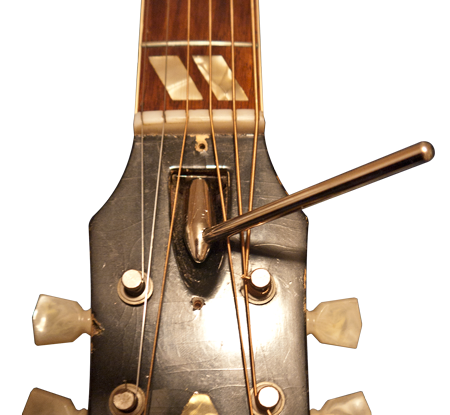
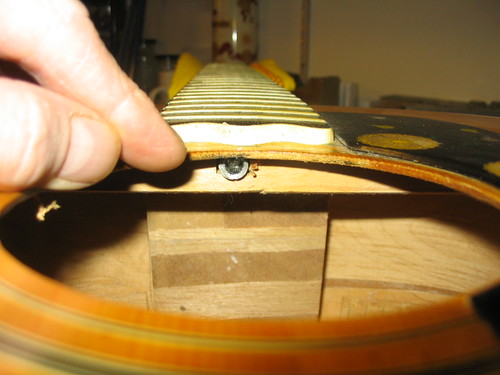

Taken from: http://www.guitarrepairbench.com/acoustic-guitar-repairs/images/acoustic-truss-rod-adjustment.png 
Taken from: http://farm4.static.flickr.com/3455/3368070468_f542e5b2fe.jpg?v=0 
Taken from: http://i2.ytimg.com/vi/IdCZEKGVZfA/mqdefault.jpg 
Taken from: http://www.stringletter.com/var/ezwebin_site/storage/images/media/agu/courses/acoustic-guitar-care-and-maintenance/how-to-set-up-your-guitar-part-1-truss-rod-adjustment/photo-gallery/truss-rod-through-soundhole/708375-1-eng-US/Truss-rod-through-soundhole_imagelarge.jpg
Taken from: http://www.sunsetstudio.net/images/trussadjust.jpg

Do not make big turns. Each turn should be no more than a quarter. After each turn, leave the guitar for about 30 minutes for the eventual curvature to set in. You can again measure the neck relief or play your guitar to determine if further adjustment is needed. You can determine the adjusted neck relief by pressing on the 8th fret while the low E string is pressed on 1st and 12th frets. Alternatively you could use the 100GSM paper to determine the desired neck relief. Repeat the illustrated processes if necessary.

The most important thing isn’t the neck relief measured figure. It is the playability. You should play the guitar to decide to adjust further or stop. Wish you the best. Thanks of reading!

Saturday, March 9, 2013

More than SIX?

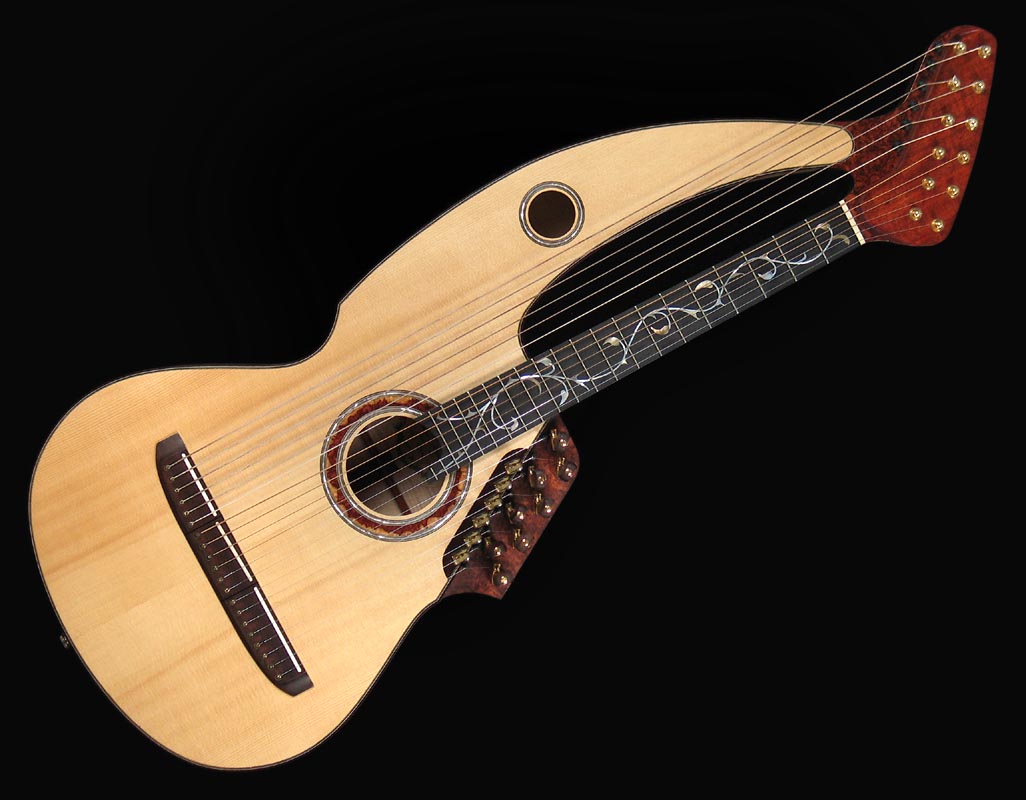
A Jeffrey Yong MonkeyPod Harp
Taken from: http://www.acousticguitarforum.com/forums/showthread.php?t=195959

Arguably the six-string guitar is the most popular musical instrument in the world. There are over 50 million guitar players worldwide. With this sheer number, we have witnesses limitless of styles in playing guitar. Invariably, the design of this instrument has evolved from one era to another. One should not be surprised by the increase in strings on guitar, isn’t it? After all, the popular 12-string guitar has found its way into many genre of music as an accompanying instrument. Have you played a 12-string guitar? Even you have not, chances are you have already seen one.

Mike Doolin's Harp Guitar
In fact, as early as 17th century, there were string instruments that have more than 12 strings. They are of various forms. As music evolves, so did string instruments. In this article, harp guitar is placed in the limelight. I have to emphasize that I am no harp guitar aficionado. Therefore my knowledge in harp guitars is at best infancy. I hope this article can arouse your interest in learning more about this wonderful instrument. For those who are keen to read a professional harp guitarist’s (Dan LaVoie) thoughts and attitude towards playing harp guitar, please scroll to the lower sections right away.

My first encounter with a harp guitar was in Oregon, Portland. I visited Mike Doolin in 2011, a luthier who resides there. Mike has just completed building a harp guitar and I was fortunate enough to sample this multi-string instrument. There are little words to describe the entire experiences. I guess the picture on the above-right said it all.

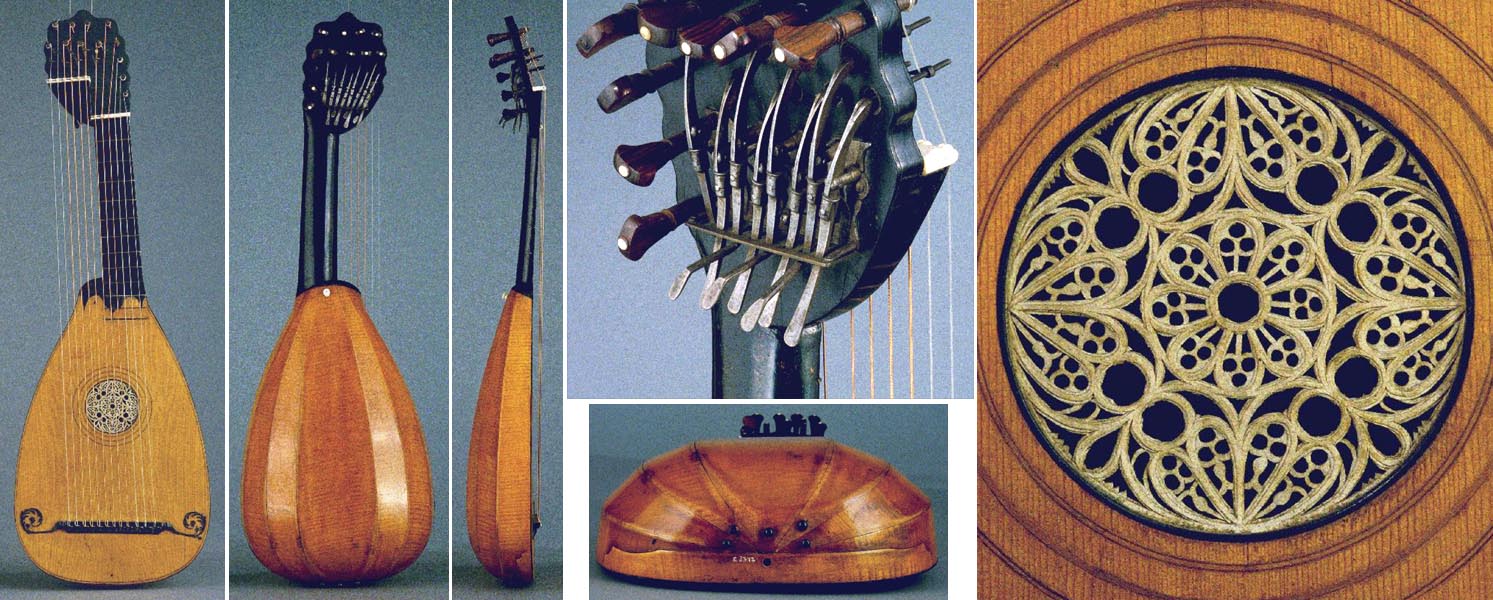
One may assume that harp guitar originated from two instruments and the successful combination of the two conceives the today harp guitar. Long before harp guitar is called harp guitar, there were already such string instruments being built. Cleary the evolution in string instruments’ design was closely related to builders’ drive to innovate and players desire to create new genre in music. Very often every birth of a new type of musical instrument, the builder has the most influence in coining a name for it. However builders were not specialized in creating names thus the past attempts were arbitrary or blatantly misleading. The picture below is a string instrument built in by Naderman (Jean-Henri), Paris, 1773. It is called bissex, which literally means twice-six.

Naderman (Jean-Henri), bissex, Paris, 1773

There is an existing classification system to name musical instruments, i.e. organology. However it isn’t perfect. It was too rigid to accommodate the evolution nature of musical instruments with regards to the evolution of harp guitars. The eventuality was harp guitars carry different names in the past and in different places.

So what is actually a harp guitar? To the regular string instrument enthusiasts the definition is probably straightforward, i.e. the best of harp and guitar combined into a single instrument.

Through my infant attempt to learn more about harp guitar, I found a wonderful website that is dedicated to harp guitars, the www.harpguitars.net. There is no need to search farther about harp guitars once you visit this cool website.

I found these definitions of harp guitars
  • A guitar, in any of its accepted forms, with any number of additional "floating" unstopped strings that can accommodate individual plucking
  • The modern harp guitar must have at least one unfretted string lying off the main fretboard; these unfretted strings are played as an open string
  • The word "harp" is a specific reference to the unstopped open strings, and is not specifically a reference to the tone, pitch range, volume, silhouette similarity, construction, floor-standing ability, nor any other alleged "harp-like" properties.

The amount of literature on harp guitars in harpguitars.net is abundance. To read all of them would take a considerable amount of time. I will make my best attempt to share the interesting perspectives and facts regarding harp guitars in this article.

So what do you play a harp guitar? The simplest answer is just pluck or strum to strings.

The modern harp guitars seen widely today have taken frame design of Chris Knutsen’s one-arm harp guitar, which was patented in 1898 (source: http://www.harpguitars.net/history/patents.htm). Subsequently, the Knutsen design harp guitar got manufactured under William James Dyer& Bro Company and that lead to the birth of Dyer Harp Guitars. The infamous Type 2 that has a cloud bass headstock is probably most liked by harp guitar aficionados. I guess one isn’t a harp guitarist if he or she doesn’t know the Dyer Type 2.

Larson made - Dyer Type 2 1904 to 1920

Most dyer harp guitars have 6 bass sub-bass strings. From my limited knowledge in harp guitars and the playing techniques, the sub-bass strings can take on any tuning as desired by the players. The string gauges are likewise. A certainty is the sustaining notes and overtones from these sub-bass strings. Once pluck, as lauded by Dan LaVoie who is a professional harp guitarists, is likened to stepping on a sustain pedal all the time. It is then necessary to be skillful in sub-bass muting.

Another popular harp guitar is the Sullivan/Elliot design. This design has included super treble strings thus 20 plus strings is common for this design. Below is a Milburn 20-string concert harp guitar, it is a faithful adaptation of the original Sullivan-Elliott harp guitar created with/for John Doan.

Milburn 20-string concert harp guitar

There is so much more about harp guitars can be shared. However I shall cease discussing about harp guitars at this point and switch to the introduction of Dan LaVoie.

I met Dan in Shanghai in 2011 during the International Finger Style Guitar Festival. He is absolutely cool and approachable. Being the only Harp Guitar player in the festival, he has certainly created an impression. There are many multi-string players but Dan is totally dedicated to harp guitars.

Dan and I
Taken from Dan’s website; “As one of the few musicians in the world actively composing and performing on the rare harp guitar, Dan LaVoie brings a unique sound and texture to fans of acoustic music… After playing the six-string guitar for several years, Dan picked up the harp guitar in 2001 and has since composed solely for this instrument. Bridge Guitar Reviews said Dan’s self-titled 2003 debut album contained “…soulful atmosphere and a skilled and progressive approach to music. The music Dan produces has deep basses and well-executed melody lines.” Click link to read more: http://www.danlavoie.com/

Enjoy a live performance of Dan in YouTube!


Regularly we converse over Facebook chat and I took the opportunity to interview this cool guy. Here it is…

Interview with Dan LaVoie, done over Facebook chat on 5 March 2013.

Me - If a layman asked;"Why are there so many strings on your guitar?" What is your response?
Dan - *laughs* I will explain that it is a harp guitar dating back to the early 19th century. Harp guitarists usually played with a mandolin player and it was called parlor music back then. It was in the 19th century that Harp Guitars fell out of fashion and people stopped playing them. Notably the ripple effects from the great depression has exacerbated the trend to minimize spending on lifestyle related items. The prolonged effects have literally killed the popularity of Harp Guitars because people simply struggled from daily related expenses let alone buying harp guitars. That is the past, at least… My love for this instrument has driven me to take on a personal mission, i.e. to bring it back from the dead and show people how much great music can be created from harp guitar. In contrast to remind string instruments lovers of what they are missing out from such an amazing instrument (Harp Guitar).

Me - So harp guitars fell out favor because they are expensive?
Dan - One of the main reasons I believed. Perhaps the size, and they are certainly harder to pick up if you compare harp to six-string guitars.

Me - Obviously with more strings, musicians will have more options. So what can you get out of Harp Guitars that a regular can't?
Dan - First the low sub basses, the rich complex overtones… almost sounds like a guitar with a sustain pedal on all the time. This brings me to the topic of sub bass muting, but we will get into that later at the workshop. I just fell in love with those tones and harp guitars instantly.

Me- In terms of genre of music, does the nature of Harp Guitar kinda restrict it?
Dan - Definitely not. I believe harp guitars have no boundary to the type of music. It is all up the player.

Me - What might a style of playing you considered not suitable to be executed on a Harp Guitar?
Dan - Well… how about "Heavy Metal?" *laughs*

Me - What about the use of guitar effects for Harp Guitar?
Dan - Well, it depends on the player. I strictly use Tc electronics... the Nova reverb, and the SCF chorus pedal (only for certain parts of a song). My first CD had a song called "On the drive home" which was recorded live in concert using a loop station.

Me - In terms of Harp Guitar players, how do you guys and gals differentiate one from another?
Dan - It boils down to personality. Everyone can play the same song on harp guitar, but each will play it differently due to personality and how one interprets the essence within the song.

Me - Who is your Harp Guitar hero(s)?
Dan - Harp Guitar heros… hmm… First on my mind is Michael Hedges, also Stephen Bennet and Andy Mckee who is like a brother to me. However most of my influences come from Michael Hedges and Richie Havens. Both will remain as my top 2. They have changed my life ever since I learned about their music and playing.

Andy McKee and Dan LaVoie

Me - So Michael Hedges and Richie Havens have inspired you to become a Harp Guitar player?
Dan - Michael Hedges inspired me to find and buy a Harp Guitar. Richie Havens' song writing and rhythm have been the vital influences and sources of inspiration in my development in harp guitar playing, which is something I try to bring into my music. And this year 2013 marks the 10th year of performing and touring with my career as a professional harp guitarists.

Me - Is family support essential to allow you to grow in Harp Guitar playing?
Dan - It was in the beginning, I believe any artist needs family support and a solid foundation in order to gain the strength to work at it.

-End of interview-

Most content written in this article with regards to harp guitar was aided by the literature from www.harpguitars.net. This amazing website is maintained by Gregg Miner. The abundance and detail provided by this website are simply unparalleled. It is already daunting to read all the articles, let alone writing them. I truly appreciate Gregg’s unrelenting attitude in emphasizing accuracy and completeness, which resulted in the many useful harp guitar articles. Thanks for reading!