


 |
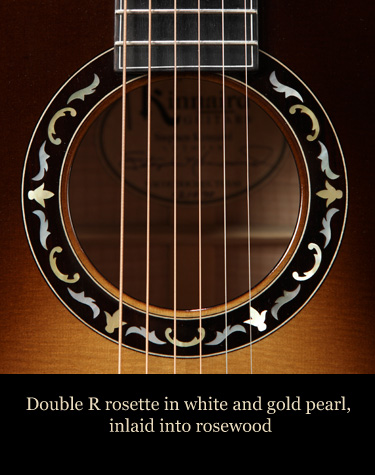
| A Kinnaird Rosette |
Attending the Guild of America Luthiers Convention was definitely exceedingly rewarding for me. Not only I have learned abundantly, I have met some luthiers who have become my friends. Stephen Kinnaird is one of them. My first encounter with a Kinniaird guitar was at Jeffrey Yong’s workshop. He showed me a Kinnaird guitar and the experience was impressionable indeed.
 |
| Stephen and I. One of his masterpiece |
With great delight, Guitaring Passionately presents an exclusive interview with Stephen Kinnaird.
Weblink: Kinnaird Guitars
 About Stephen
1. Why make guitars?
The short answer is, simply, that I love them! I love their sound, their shape, and the fact that they are a joy to play. Also I love wood, the raw material from which guitars are built.
So, guitar-making combines two things that really stir me. Plus, it’s hard to describe just how rewarding it is to finish an instrument, and then play it. To go from raw materials to music is magical!
2. Can you make other stuff too?
I assume you mean other musical instruments? Our shop also builds electric guitars and mountain dulcimers. Plus, we have some interesting things in development, like ukuleles, baritone guitars, acoustic bass guitars and even harp guitars.
 3. Where did you train?
I am largely self-taught. Much reading, experimenting, and talking to other luthiers who were also trying to figure these things out. I have benefited greatly from the advice and help of mentors and colleagues who have been happy to pass along their understanding of the craft.
4. What influences you?
Anyone who practices a craft draws inspiration from as many sources as possible, so a lot of things influence me. First would be tradition. I love the old Martin guitars of the late 1800’s to early 1900’s. There is an honesty, an integrity in their work that I find compelling. That is the “sound” that I work toward. However, I also love a good bit of today’s modern approach to lutherie, especially in the area of aesthetics. Rosettes, purflings, inlays—there is so much creative work going on in these areas now that I find liberating. What some luthiers are doing today is stunning. Fred Carlson, Steve Klein, Jeff Elliott, these guys and a host of others both influence and inspire me.
 5. How long has it been?
How long have I been a luthier? I first became interested in lutherie in 1972. This came about by meeting a man by the name of Jay Rhyne. He was the first luthier I met, and he was a real inspiration to get started. I learned as much as I could, while finishing college, and managed to do some repairs and build some dulcimers. The first guitar was built in 1980, so this year marks 32 years as a guitar maker.
6. Was there a time(s) when you wish to stop?
What a question! There were some times when I had to stop, for various reasons: school, work, church. But the only times I wanted to stop were those times when I was disgusted with myself and the flaws I was making. Lutherie is quite demanding, and there’s nothing like making a musical instrument that will reveal your own flaws to you. Those are the things one has to press through in order to improve—not just as a luthier, but more importantly as a person.
About Kinnaird guitars
1. Are your guitars works of an artist, scientist or craftsman?
 Another good question. I like to think that all three elements are there, combined in each guitar we build. There has to be the artistic vision, then the scientific reality if the thing is going to work, and then the craftsman has to roll up his sleeves and build the guitar. Each aspect is essential, and in a successful instrument all three areas blend happily.
2. What is unique about your guitars (work)?
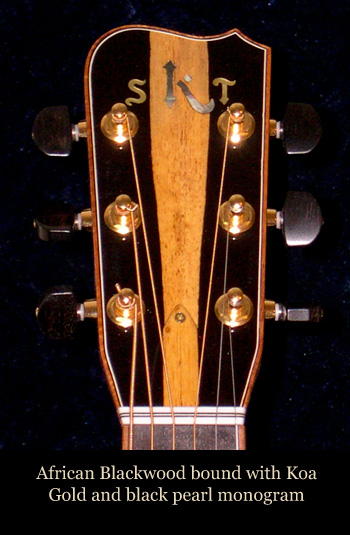
With so many people building guitars now, it’s difficult to be truly unique. And, it is a goal of ours not to be different just for the sake of being different! However, each guitar is a reflection of what we love, and our own sense of style. In our design aesthetic we are fairly traditional. But we do enjoy working with alternative species of wood, and endeavor to combine our wood choices very carefully. Some of our shapes are originals, as is our peghead design and logo. So I like to think that a Kinnaird guitar is recognizable, that it does stand apart.
 3. What guides you during the making process?
Love of the guitar, first and foremost. Then, the realization that what we are making is a musical instrument. By that I mean that precision in every step is essential. A flaw at any point of construction can yield unacceptable results later. Next, the understanding that the factories can turn out guitars so much more quickly, at such a lower price, our work has to excel.We have to deliver something that a factory just can’t, or won’t.
4. The most difficult part(s) is…??
a. If building for a client, fully accomplishing their every wish. Interpreting and expressing in wood what is to them, at first, only a dream or a sound in their head.
 b. If building a “spec” guitar, designing something that has the broadest appeal, while remaining true to our own vision.
Let me add that these are the most rewarding aspects as well!
5. Is there a Kinnaird voice in your guitars?
Indeed there is. Of course body size/shape and wood choices will yield predictable results, altering the voice in definite ways. But through it all, our guitars sound like our guitars. It is a sound I love: large, warm, musical.
All pictures are taken with kind permission from Stephen Kinnaird Guitars' website
-End of Interview-


